Researching, in their own context, artists significant in modern Brazilian art history, and learning about the contemporary South-American art scene were among the primary aims of my coming to Brazil. Largo das Artes has extensive connections in the Rio artworld and residents are well taken care of with regular recommendations and visits to museums, galleries, openings and other art-related events.
While—contrary to my expectations—I did not get to see any of Lygia Clark's pieces in Rio, I've noticed a strong connection between art and psychotherapy in contemporary art that she had helped to champion. I wonder whether, in fact, this connection is due to the influence of her work or if there is a uniquely Brazilian emphasis on exploring and expressing intangible spiritual dimensions. (While I did not have a chance to see her work here, on the other hand, the recent MoMA exhibit of Lygia Clark's work has an excellent online resource of videos and catalogued artworks.) Clark's later work emphasized sensory perception that is taken out of the exclusive realm of the visual and focused on the psychologically charged interaction between artwork and participant. She has referred to her interactive pieces as ones to create a "ritual without myth."
While Clark has eluded me the whole time (her work is too fragile to be on permanent view and, as I've heard, has also been a subject of disputes between her estate and collections,) I got to learn more details about Helio Oiticica's oeuvre. During his short life Oiticica produced works both experimental and wide-ranging so that his brands of artworks (e.g. Tropicalias, Penetrables, and Parangoles) created a permanent touchtone for contemporary Brazilian art theory, which in turn spurred on a younger generation of artists. His artistic persona and his work has been successfully mythologized under the stewardship of his brothers and the artworld. In the fall of 2015, a documentary made by brother Cesar, on the life of Helio Oitica will be released in New York.
Helio Oiticica: Parangole
There is an extremely strong trend of conceptual art tradition is Brazil that is often connected to living during the military dictatorship. In contemporary art, there is a generation of much revered mature artists, like Antonio Dias, Cildo Mereiles, and José Damasceno, who further a conceptual approach that is simultaneously material orieneted, each making it into his own uniquely different brand. Much to my surprise, Eduardo Kac, the artist of the glow-in-the-dark bunny, Alba, has also come from these conceptual beginnings. Kac's early work, made in Brazil in the early 1980's focused on language, abstraction, and technology. The artifacts of his inquiry into methods of transcription were extremely interesting to see in the Laura Marsiaj Gallery, especially that Eduardo was kind enough to supply detailed explanations about the now obsolete technologies he used for making these pieces. Kac lives and works in Chicago. Meeting him in Rio and listening to his explanations fluidly moving from Portuguese to English was an interesting but oddly confusing experience.
Eduardo Kac in a gallery talk at Laura Marsiaj Gallery.
The same odd out-of-place encounter has happened with author Sarah Thornton, whose new book "O que é um artista?" (What is an artist?) was released in Brazil in April. Thornton gave a talk in Parque Lage to an overflow audience. During the talk, she presented many intriguing stories and artist characters from her book, which is a result of insightful interviews and discussions with her large sample of artist subjects, many of whom she had to pull strings with in order to have this kind candid and exclusive access to. After the talk, I tried to inquire if her findings about what makes an artist were applicable to a much larger population of mainstream and emerging artist, or were they merely "celebrity gossip" we all enjoy but have very little generalizations to make from. We had an interesting but non-conclusive conversation about this. Since then, I had a chance to read the book, which I find very thoughtful and well researched, yet still a bit in the realm of quality entertainment rather than something I would assign to my students.
If there was one artist I really had wanted to meet in Rio, that would have to be Ernesto Neto, whose room size installation at the Henry Art Gallery, entitled the Flying Gloup Nave, was a formative experience during my gradschool years. His work had opened up an entire world of possibilities about sculpture that is both object-like/bodily and spatial/architectural; both sensual as well as completely trivial (I should have used the words accessible or domestic here). I liked the fact that his work was made on a scale of a building but with materials and processes that are assigned to the feminine: thousands of little stitches, threads and connections, elastic surfaces that could be pulled, stretched and expanded.
In early May, the wonderful Casa Daros held a "bate-papo" (chat) with Neto, which gave me the first chance to meet him. After sitting through two hours of meandering stories in his animated Portuguese that ranged from his becoming an artist (through astronomy) to his ideas about education (movement and dance instead of book-learning); from Brancusi's Kiss to criticizing FIFA—in much of this I only understood what the story was about but not the actual details of how it went—I had a chance to introduce myself and have a brief chat. I learned that his 2006 exhibition in the 'le Panthéon', Paris was made in the space that is my studio in Largo das Artes.
A fan-picture with Ernesto after his lecture.
Embraced by a Neto sculpture in Casa Daros.
A few weeks later, with Largo director, Miguel Sayad's help, we were to visit Neto's atelier, also located in the Centro, a few blocks away from our studio. His workshop takes up a three-story building and it functions more-or-less like a factory. Stairs separate the prep and install areas (ground floor) that have many workers, from the sewing and storage rooms (middle level) that only have a few specialized assistants, finally arriving to Neto's private space (on top floor). The studio building is both magical and completely down-to-earth practical. There are lots of video-interviews available online in which Neto speaks about the work that goes on and the workers he employs from the favela communities. Although this question was not raised during our conversation, I found him to be genuinely interested in the betterment of his community and in the social, emotional and cultural well-being of Brazilian society in general. Our discussion lasted about an hour and was somewhat strange. Somehow most of the discussion revolved around indigenous spiritual traditions, many of which Neto is both interested in and, apparently, practices. I've noticed before that the use of certain psychotropics is widely condoned in Brazil, as a way of both accepting the indio heritage of using plant substances for making a connection with nature and the spiritual realms, and also as a way of accessing one's own otherwise unreachable psychic dimensions. To my question about what he thinks of the critical discourse around his work (since I've never see the ideas he mentioned anywhere in the writings of curators and art critics), the artist said that he nearly never reads these, or when he does much later, he tends to ignore them. Even if this was an exaggeration, he seemed to imply that his work springs from a completely introverted origin, one that is very personal to him and thus can exists in such isolation. He seemed to say that when people find a way to relate to his work it amuses him, but does not affect or feed his process, which exists only for his own reasons. I find this self-centered certainty to be an admirable model to follow.
The entry to the second floor is shaped like the characteristic orifices.
Ground floor was turned into a dye studio just a few weeks before, in order to complete a project.
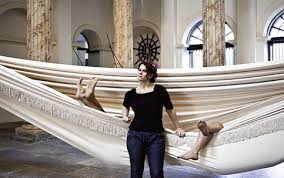
We were lucky enough to have a chance to try out the large hammock-like piece before it was crated and shipped to Austria for a show.
The hammock is going into the crate.
Leaving Neto's studio, I was reminded of the ripple effect an art artifact, idea or artist may have. Neto is partially responsible for one of the most interesting galleries in Rio: Gentil Carioca. Gentil Carioca takes on an unassuming building in the SAARA, very close to Largo das Artes. Their profile is half-way between a commercial art gallery and a non-profit. Gentil Carioca furthers the career of a strong cohort of young Brazilian artists such as Maria Nepomuceno and Laura Lima but also maintains a very unusual initiative, which supports the education of kids in communities that otherwise would not have access to art.
Finally, in the "new generation of Brazilian artist" it's worth mentioning more about the one everyone talks about–also a Carioca—Laura Lima. I did not get to meet her but saw her much discussed piece in the group show "Encruzilhada" (Crossroads) at Parque Lage. The piece is a naked man—tethered to ropes and cords that are anchored to the trees outside and run through the open windows—who, like Sisyphus, painfully struggles about with the dead weight. Lima's performances are a little too didactic too my taste and while they never feature the artist herself, too reminiscent of early performances by Marina Abramovic. But there is one that has just came to my attention this week, as it is about to open in the National Gallery of Denmark. The work, entitled The Naked Magician, is an installation with a performer. It is theatrical and laden with metaphors. I see lots of common threads between her brand and the way I tend to work. Even her slightly didactic but disjoint and layered narratives resonate with me. Lima has a degree in philosophy.
Laura Lima: The Naked Magician
Laura Lima with her two "disinterested observer" performers in the hammock.
Dar Uma Palavra. Ter Uma Palavra. (Give a Word. Have a Word.) Documentation of the participatory word exchange project at Largo das Artes, May 12th 2105.
I've been fascinated with the Portuguese language since arriving to Brazil. In particular, with the sing-songy dialect of Brazilian Portuguese spoken in Rio. I regret now not having the time for classes in advance, which would have prepared me with an understanding of the grammar and syntax. But learning on the fly has been fun, especially that (thanks to smart phones and translator apps) help is always at hand. I made best friends with the soft female voice of the text-to-speech translator app from which I learned my pronunciation and, in the studio, I rely constantly on the aid of Brazilian artist friends. Many of them had been living or studying abroad for years or, in the case of the younger ones (being part of the fully connected Millennial generation) have learned fluent English through the Internet.
Outside of a small circle of travelled or business people, very little English is spoken in Brazil. For this reason, I had decided early to try to communicate in Portuguese as much as possible, only reverting to a feeble voiced "Você fala Inglês? Eu não falo Português." when the conversation situation gets really confusing.
In the first week of our stay, I was dispatched to our neighborhood drinking water store (armed with a cheat-card of possible sentences that I had made beforehand) to place an order for a home delivery of a replacement wanter tank. (Unless the home has a water filter system, potable water in Rio, sadly, comes from the store in a 20 liter plastic tank.) Five weeks later, I participated in a day-long workshop on Places and the City lead by artists Gustavo Ciriaco and Fernanda Eugenio and attended a two-hour "bate-papo" (chit-chat) with Ernesto Neto (all in Portuguese). Yesterday, I made my first phone call. I still can't muster more than a baby-talk but understand enough to get by and able to comprehend a large percentage of almost any kind of printed information (thanks to other Latin languages I had encountered).
During the participatory project, "Dar Uma Palavra. Ter Uma Palavra." participants not only explain the meaning of the word to me but also patiently correct my pronunciation. The conversations are in Portuguese or, rarely, bi-lingual and most people curiously flip through the log to see the words given by others and to discuss what words they like and why.
A page from the logbook showing some of the words received.
Back in Seattle, I had a project idea for some kind of an exchange to be done in Rio that would take place in the public space. With the students of my Art and Social Practice class, we always close the quarter with a project that asks them to learn a forgotten skill and not only to make some kind of a gift with it, but also to document and present their learning process with the purpose of transmitting the making skill to the rest of us. It's a very popular project, and when taken seriously, it results in a great deal of information acquired and in a "white elephant exchange" of the resulting gifts. This gave me the idea for the initial plans for a participatory exchange project in Rio. There are lots of makers here. Many of them conduct their craft on the street: from caning chairs to cooking food.
For many weeks, I was looking for both a way and a place to exchange various kinds of skills with the public but could not find a simple method for doing it. Slowly, it has become apparent that language itself should be the subject and the material of such exchange. I would be both the transmitter and the beneficiary of words passed on and acquired.
I act as a scribe, a relay, while everyone who participates by giving a word would also become a receiver. Each card handprinted with the letters of the word arranged in a composition and signed in the back with the word given and the date of the exchange.
I tested simple processes by which I can quickly form any word that is given to me in Portuguese and pass it on to the contributors in some kind of material form as a token of our exchange. Since my last project involved cutting out words, my first attempt for this was in the form of cutting vinyl, which proved to be a slow multi-step process. After a few hours of brainstorming with the British artist Claire Nichols, which helped to clear my mind and articulate some do's and don'ts of my priorities, I quickly arrived at the final solution: using the cut-outs of individual letters as rubber stamps. The words then can be arranged from the letters in the form of concrete poetry, following the venerable Brazilian tradition of Augusto de Campos, Ferreira Gullar, Eduardo Kac, Lygia Pape and others. Each word is printed to be given away as a greeting card size text-object.
Building the letter-poem.
Some of the printed cards ready to be taken away.
During residencies, ideas are turned into projects on a rather short order. Often, they would deserve longer time to mature but time goes by quickly and there is much more to see, consider and do!
In a matter of a weekend, I've had the wood cut and prepared, and have collected all the letters that I wanted to use. During a few late-nighters the stamps were made and I was able to conduct the first test run of the project during the reception of “Transição e Queda,” a group exhibition that opened on May 12th at Largo das Artes.
The typography for each letter was selected from my own photographs of Rio street signs and markings, including business logos, official and informal hand-made street signage as well as graffiti. Each letter is re-drawn on a 3x3cm scale, cut in rubber and glued on a wooden block.
Lacking the proper tools at Largo, I had to find a neighborhood shop selling wood (madeira) and talk this nice man into cutting it into little blocks for me. After our lengthy negotiation he climbed up to the attic to find a piece of material, then came down with something very different from what we had agreed upon. Next, he set the rusty old table saw and cut it to the exact square stock, then into the pieces I asked for. He even had to make the tool with which he pushed the tiny blocks through the saw. He only charged me for the wood and not for his labor and taught me words like "lixa" (sandpaper). He was perplexed to hear that I needed these for an art project. The wood is some kind of native Brazilian wood. Smells delicious and has a beautiful grain.