Showing posts with label community. Show all posts

Thursday, June 4, 2015

Serendipitous encounters

Researching, in their own context, artists significant in modern Brazilian art history, and learning about the contemporary South-American art scene were among the primary aims of my coming to Brazil. Largo das Artes has extensive connections in the Rio artworld and residents are well taken care of with regular recommendations and visits to museums, galleries, openings and other art-related events.
While—contrary to my expectations—I did not get to see any of Lygia Clark's pieces in Rio, I've noticed a strong connection between art and psychotherapy in contemporary art that she had helped to champion. I wonder whether, in fact, this connection is due to the influence of her work or if there is a uniquely Brazilian emphasis on exploring and expressing intangible spiritual dimensions. (While I did not have a chance to see her work here, on the other hand, the recent MoMA exhibit of Lygia Clark's work has an excellent online resource of videos and catalogued artworks.) Clark's later work emphasized sensory perception that is taken out of the exclusive realm of the visual and focused on the psychologically charged interaction between artwork and participant. She has referred to her interactive pieces as ones to create a "ritual without myth."

While Clark has eluded me the whole time (her work is too fragile to be on permanent view and, as I've heard, has also been a subject of disputes between her estate and collections,) I got to learn more details about Helio Oiticica's oeuvre. During his short life Oiticica produced works both experimental and wide-ranging so that his brands of artworks (e.g. Tropicalias, Penetrables, and Parangoles) created a permanent touchtone for contemporary Brazilian art theory, which in turn spurred on a younger generation of artists. His artistic persona and his work has been successfully mythologized under the stewardship of his brothers and the artworld. In the fall of 2015, a documentary made by brother Cesar, on the life of Helio Oitica will be released in New York.
Helio Oiticica: Parangole
There is an extremely strong trend of conceptual art tradition is Brazil that is often connected to living during the military dictatorship. In contemporary art, there is a generation of much revered mature artists, like Antonio Dias, Cildo Mereiles, and José Damasceno, who further a conceptual approach that is simultaneously material orieneted, each making it into his own uniquely different brand. Much to my surprise, Eduardo Kac, the artist of the glow-in-the-dark bunny, Alba, has also come from these conceptual beginnings. Kac's early work, made in Brazil in the early 1980's focused on language, abstraction, and technology. The artifacts of his inquiry into methods of transcription were extremely interesting to see in the Laura Marsiaj Gallery, especially that Eduardo was kind enough to supply detailed explanations about the now obsolete technologies he used for making these pieces.  Kac lives and works in Chicago. Meeting him in Rio and listening to his explanations fluidly moving from Portuguese to English was an interesting but oddly confusing experience.
Eduardo Kac in a gallery talk at Laura Marsiaj Gallery.
The same odd out-of-place encounter has happened with author Sarah Thornton, whose new book "O que é um artista?" (What is an artist?) was released in Brazil in April. Thornton gave a talk in Parque Lage to an overflow audience. During the talk, she presented many intriguing stories and artist characters from her book, which is a result of insightful interviews and discussions with her large sample of artist subjects, many of whom she had to pull strings with in order to have this kind candid and exclusive access to. After the talk, I tried to inquire if her findings about what makes an artist were applicable to a much larger population of mainstream and emerging artist, or were they merely "celebrity gossip" we all enjoy but have very little generalizations to make from. We had an interesting but non-conclusive conversation about this. Since then, I had a chance to read the book, which I find very thoughtful and well researched, yet still a bit in the realm of quality entertainment rather than something I would assign to my students.

If there was one artist I really had wanted to meet in Rio, that would have to be Ernesto Neto, whose room size installation at the Henry Art Gallery, entitled the Flying Gloup Nave, was a formative experience during my gradschool years. His work had opened up an entire world of possibilities about sculpture that is both object-like/bodily and spatial/architectural; both sensual as well as completely trivial (I should have used the words accessible or domestic here). I liked the fact that his work was made on a scale of a building but with materials and processes that are assigned to the feminine: thousands of little stitches, threads and connections, elastic surfaces that could be pulled, stretched and expanded.
In early May, the wonderful Casa Daros held a "bate-papo" (chat) with Neto, which gave me the first chance to meet him. After sitting through two hours of meandering stories in his animated Portuguese that ranged from his becoming an artist (through astronomy) to his ideas about education (movement and dance instead of book-learning); from Brancusi's Kiss to criticizing FIFA—in much of this I only understood what the story was about but not the actual details of how it went—I had a chance to introduce myself and have a brief chat. I learned that his 2006 exhibition in the 'le Panthéon', Paris was made in the space that is my studio in Largo das Artes.
A fan-picture with Ernesto after his lecture.
Embraced by a Neto sculpture in Casa Daros.


A few weeks later, with Largo director, Miguel Sayad's help, we were to visit Neto's atelier, also located in the Centro, a few blocks away from our studio. His workshop takes up a three-story building and it functions more-or-less like a factory.  Stairs separate the prep and install areas (ground floor) that have many workers, from the sewing and storage rooms (middle level) that only have a few specialized assistants, finally arriving to Neto's private space (on top floor). The studio building is both magical and completely down-to-earth practical. There are lots of video-interviews available online in which Neto speaks about the work that goes on and the workers he employs from the favela communities. Although this question was not raised during our conversation, I found him to be genuinely interested in the betterment of his community and in the social, emotional and cultural well-being of Brazilian society in general. Our discussion lasted about an hour and was somewhat strange. Somehow most of the discussion revolved around indigenous spiritual traditions, many of which Neto is both interested in and, apparently, practices. I've noticed before that the use of certain psychotropics is widely condoned in Brazil, as a way of both accepting the indio heritage of using plant substances for making a connection with nature and the spiritual realms, and also as a way of accessing one's own otherwise unreachable psychic dimensions. To my question about what he thinks of the critical discourse around his work (since I've never see the ideas he mentioned anywhere in the writings of curators and art critics), the artist said that he nearly never reads these, or when he does much later, he tends to ignore them. Even if this was an exaggeration, he seemed to imply that his work springs from a completely introverted origin, one that is very personal to him and thus can exists in such isolation. He seemed to say that when people find a way to relate to his work it amuses him, but does not affect or feed his process, which exists only for his own reasons. I find this self-centered certainty to be an admirable model to follow.
The entry to the second floor is shaped like the characteristic orifices. 
Ground floor was turned into a dye studio just a few weeks before, in order to complete a project. 
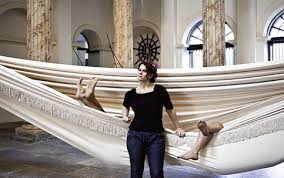
We were lucky enough to have a chance to try out the large hammock-like piece before it was crated and shipped to Austria for a show. 
The hammock is going into the crate. 
Leaving Neto's studio, I was reminded of the ripple effect an art artifact, idea or artist may have. Neto is partially responsible for one of the most interesting galleries in Rio: Gentil Carioca. Gentil Carioca takes on an unassuming building in the SAARA, very close to Largo das Artes. Their profile is half-way between a commercial art gallery and a non-profit. Gentil Carioca furthers the career of a strong cohort of young Brazilian artists such as Maria Nepomuceno and Laura Lima but also maintains a very unusual initiative, which supports the education of kids in communities that otherwise would not have access to art.

Finally, in the "new generation of Brazilian artist" it's worth mentioning more about the one everyone talks about–also a Carioca—Laura Lima. I did not get to meet her but saw her much discussed piece in the group show "Encruzilhada" (Crossroads) at Parque Lage. The piece is a naked man—tethered to ropes and cords that are anchored to the trees outside and run through the open windows—who, like Sisyphus, painfully struggles about with the dead weight. Lima's performances are a little too didactic too my taste and while they never feature the artist herself, too reminiscent of early performances by Marina Abramovic. But there is one that has just came to my attention this week, as it is about to open in the National Gallery of Denmark. The work, entitled The Naked Magician, is an installation with a performer. It is theatrical and laden with metaphors. I see lots of common threads between her brand and the way I tend to work. Even her slightly didactic but disjoint and layered narratives resonate with me. Lima has a degree in philosophy.

Laura Lima: The Naked Magician
Laura Lima with her two "disinterested observer" performers in the hammock.

Monday, July 7, 2014

Community and Craft: Ellensburg - A History Lesson


Ellensburg may not seem like an exotic destination for someone from the Northwest but the small Central Washington town (population about 20,000) offers much in terms of its history, a beautiful location in the otherwise arid landscape, and its thriving community arts and culture.

Davidson building from 1889. Now home of Gallery One.

This year, Gallery One Visual Arts Center inaugurated a new ceramics residency program in order to reinvigorate its clay studio. I was excited to be offered an opportunity to visit and create work there, since my work of the past few years is strongly oriented towards building structures, architecture, and interaction with various communities. In our discussions about the scope of the residency with director Monica Miller, we had discovered common threads in our goals: to create an engagement between my research and Ellensburg residents, by drawing people into the studio and also by hooking me up with some members of the community, in order to mine and record some of the oral history of the town.

Kittitas County Historic Museum

My residency takes form in three stages: First stage is a preliminary research, which, by now, I have completed. The second is a community workshop, which will take place at the end of July, and the third is a public presentation in August of the pieces made in the workshop.

Barge Hall on the CWU campus

During the past week, I've been wondering around town on my own photographing the buildings, getting tours from generous and knowledgeable gems of Ellensburg residents, like David Wheeler, a local historian and building aficionado, Mollie Edson, proprietor of the historic 420 Building, and Jane Orleman of Dick and Jane's Spot, a painter.


The Art Deco 420 Building.


From what I was able to observe, Ellensburg is a combination of three things that signify the place and keep being intertwined mutually facilitating the growth of one another over the past century and a quarter: community, culture and history, - creating a perfect place for an artist.
Another facet of a small town is the unhurried way of life, and the social contract created by everybody knowing everyone (for better or worse).

After I settled into the studio and made a few tests with the materials available, I headed out in the company of David Wheeler to get my first history lesson on Ellensburg.
While the Kittitas tribes has used the valley as trade and council grounds for many decades before the first white settlers laid an eye on the beautiful location by the Yakima river, it was not a permanent settlement site until the mid 1800s. In barely more than two decades after the first permanent white settlement was established, a flourishing town complete with a bank, a few hotels and eateries, many saloons, stables, schools, stores and various other businesses was welcoming the travelers en-route in their grueling journey from the Midwest to the Pacific Coast or from the traders conducting business of cattle, and natural resources from the Columbia river northward. The Northern Pacific Railroad built a depot in 1886, and the town was growing so rapidly that in 1889, when Washington territory became a state, Ellensburg became a strong contender in a bid for the state capital. The milestone moment came 125 years ago, on the 4th of July, in the form of a blazing fire that destroyed much of the downtown core. The expansion was only momentarily stunned by the destruction, but only to rebuild with even more resolve, quickly and furiously. Much of the building materials had already been ordered amidst the vigorous expansion and these became the fundamental first-aid during the process of the rebuild, which actually happened in only 90 days!!!
In the following decades, many other events promoted the renewal and redevelopment of the town, now shaping itself to be a center of education (Washington Sate Normal School in 1891, pilot training during WW II. - now Central Washington University) and trade (a special type of hay for race horses).


Downtown street corner with mural.

Dick and Jane's Spot.


Looking at the details of the buildings and listening to David retelling these stories, two things stand out for me from all this history: Community and Craft.

Community:
The old YMCA building now.

Both after the Independence Day Fire and upon the return of the veterans of World War I and II, or even now during the time of our current economic ailments, a strong sense of inter-reliance and shared responsibility for the future permeates all the discussions. One example for that is values and ideas represented and promoted by the stellar Gallery One Visual Arts Center and the other is the brand new community radio station.


Craft:
Check out the brick work!
During my week-long residency, I've met more artists, crafts people, makers, creative-types, innovators and entrepreneurs - both living in Ellensburg or visiting, than I meet in a usual week back home in Seattle.
Another aspect of Craft comes from having only limited resources, creating a more resourceful approach to making it due with what's available. This is clearly visible in the brick work on the building fronts. This kind of resourcefulness of pushing and pulling the bricks to create endless variations of patterns is a testament to the craftsman's technical savvy and design ingenuity.


On one of my walks I found a curious looking residential home, affectionately named Dick and Jane's Spot. On the fence is a loud sign: "What is This?" - exactly a question in my mind. The next day, I was lucky enough to meet Jane Orleman, the lady of the house, for a discussion and a tour of her home. Jane gave me another chapter to Ellensburg history: from the 1970's to the present. As young artists and graduates of CWU's art program, she and Richard C. Elliott bought a run-down house, which over the following three decades they developed into a whimsical sculpture garden, equally for their own amusement and that of the tourists' who have been curiously peeking over the fence ever since.

Dick Elliott's trademark pattern work with reflectors. He developed a mathematical algorithm to produce permutations of the design. One of his public artworks is on the North part of the Henry Art Gallery on the UW Seattle campus.
Jane spoke about the local support she received in showing her then "outrageous" paintings about domestic violence and child abuse, and how Dick (who was a renowned public artists with numerous commissions nation-wide) and her considered Ellensburg their home-base and center.
Jane Orleman in her studio.


While I was working in the Gallery One clay studio many visitors made a stop for casual or inquisitive conversations.
This is one of the larger and more complex pieces. It's not directly referencing any of the buildings but still has a few design elements mixed together.

I learned about "moon gardens," the local hay business, a general lack of art education in the school system, the efforts going into making the town a cultural center and a destination, the Ellensburgians wary to utter the word "wind". (Instead you have to spell it out: W-I-N-D, in order to avoid it returning. The wind can be quite unsettling in its relentless presence. I went out for a run on a moderately windy day and got almost blown off my feet while going through the open fields. I felt like a fool out there struggling to move forward while barely keeping my balance.)

Although I made quite a few things in the studio while there, much of this experience will shape into its final form later in my own studio and during the community workshop at the end of the month. Again: Ceramics is such a process! - from start to result. Takes a while to test and get the materials ready in the beginning, and it takes a while to get the end result fired and finished.
I also noticed a certain adult bias to relegate working with clay to be either a functional craft or children's art. It may be just some shyness, the adults thinking of purpose and utilitarian product.
I hope the upcoming workshop to sway that. Here is a great inspiration:


I actually found this picture in the Ellensburg online archives. It is so intriguing. I believe the building was on fire in the dead of winter, so the water froze on it as it was being sprayed by the firemen. The ice has a visual relationship to the way I use the slip to hold the pieces together in my structures.

And below are some work in progress:
Working with slip and glaze inlays to add pattern. These are stoneware slabs, a lot thicker than my usual work with porcelain.
Little structures are going into the kiln.


Out of the kiln.