Researching, in their own context, artists significant in modern Brazilian art history, and learning about the contemporary South-American art scene were among the primary aims of my coming to Brazil. Largo das Artes has extensive connections in the Rio artworld and residents are well taken care of with regular recommendations and visits to museums, galleries, openings and other art-related events.
While—contrary to my expectations—I did not get to see any of Lygia Clark's pieces in Rio, I've noticed a strong connection between art and psychotherapy in contemporary art that she had helped to champion. I wonder whether, in fact, this connection is due to the influence of her work or if there is a uniquely Brazilian emphasis on exploring and expressing intangible spiritual dimensions. (While I did not have a chance to see her work here, on the other hand, the recent MoMA exhibit of Lygia Clark's work has an excellent online resource of videos and catalogued artworks.) Clark's later work emphasized sensory perception that is taken out of the exclusive realm of the visual and focused on the psychologically charged interaction between artwork and participant. She has referred to her interactive pieces as ones to create a "ritual without myth."
While Clark has eluded me the whole time (her work is too fragile to be on permanent view and, as I've heard, has also been a subject of disputes between her estate and collections,) I got to learn more details about Helio Oiticica's oeuvre. During his short life Oiticica produced works both experimental and wide-ranging so that his brands of artworks (e.g. Tropicalias, Penetrables, and Parangoles) created a permanent touchtone for contemporary Brazilian art theory, which in turn spurred on a younger generation of artists. His artistic persona and his work has been successfully mythologized under the stewardship of his brothers and the artworld. In the fall of 2015, a documentary made by brother Cesar, on the life of Helio Oitica will be released in New York.
Helio Oiticica: Parangole
There is an extremely strong trend of conceptual art tradition is Brazil that is often connected to living during the military dictatorship. In contemporary art, there is a generation of much revered mature artists, like Antonio Dias, Cildo Mereiles, and José Damasceno, who further a conceptual approach that is simultaneously material orieneted, each making it into his own uniquely different brand. Much to my surprise, Eduardo Kac, the artist of the glow-in-the-dark bunny, Alba, has also come from these conceptual beginnings. Kac's early work, made in Brazil in the early 1980's focused on language, abstraction, and technology. The artifacts of his inquiry into methods of transcription were extremely interesting to see in the Laura Marsiaj Gallery, especially that Eduardo was kind enough to supply detailed explanations about the now obsolete technologies he used for making these pieces. Kac lives and works in Chicago. Meeting him in Rio and listening to his explanations fluidly moving from Portuguese to English was an interesting but oddly confusing experience.
Eduardo Kac in a gallery talk at Laura Marsiaj Gallery.
The same odd out-of-place encounter has happened with author Sarah Thornton, whose new book "O que é um artista?" (What is an artist?) was released in Brazil in April. Thornton gave a talk in Parque Lage to an overflow audience. During the talk, she presented many intriguing stories and artist characters from her book, which is a result of insightful interviews and discussions with her large sample of artist subjects, many of whom she had to pull strings with in order to have this kind candid and exclusive access to. After the talk, I tried to inquire if her findings about what makes an artist were applicable to a much larger population of mainstream and emerging artist, or were they merely "celebrity gossip" we all enjoy but have very little generalizations to make from. We had an interesting but non-conclusive conversation about this. Since then, I had a chance to read the book, which I find very thoughtful and well researched, yet still a bit in the realm of quality entertainment rather than something I would assign to my students.
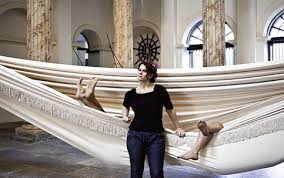
If there was one artist I really had wanted to meet in Rio, that would have to be Ernesto Neto, whose room size installation at the Henry Art Gallery, entitled the Flying Gloup Nave, was a formative experience during my gradschool years. His work had opened up an entire world of possibilities about sculpture that is both object-like/bodily and spatial/architectural; both sensual as well as completely trivial (I should have used the words accessible or domestic here). I liked the fact that his work was made on a scale of a building but with materials and processes that are assigned to the feminine: thousands of little stitches, threads and connections, elastic surfaces that could be pulled, stretched and expanded.
In early May, the wonderful Casa Daros held a "bate-papo" (chat) with Neto, which gave me the first chance to meet him. After sitting through two hours of meandering stories in his animated Portuguese that ranged from his becoming an artist (through astronomy) to his ideas about education (movement and dance instead of book-learning); from Brancusi's Kiss to criticizing FIFA—in much of this I only understood what the story was about but not the actual details of how it went—I had a chance to introduce myself and have a brief chat. I learned that his 2006 exhibition in the 'le Panthéon', Paris was made in the space that is my studio in Largo das Artes.
A fan-picture with Ernesto after his lecture.
Embraced by a Neto sculpture in Casa Daros.
A few weeks later, with Largo director, Miguel Sayad's help, we were to visit Neto's atelier, also located in the Centro, a few blocks away from our studio. His workshop takes up a three-story building and it functions more-or-less like a factory. Stairs separate the prep and install areas (ground floor) that have many workers, from the sewing and storage rooms (middle level) that only have a few specialized assistants, finally arriving to Neto's private space (on top floor). The studio building is both magical and completely down-to-earth practical. There are lots of video-interviews available online in which Neto speaks about the work that goes on and the workers he employs from the favela communities. Although this question was not raised during our conversation, I found him to be genuinely interested in the betterment of his community and in the social, emotional and cultural well-being of Brazilian society in general. Our discussion lasted about an hour and was somewhat strange. Somehow most of the discussion revolved around indigenous spiritual traditions, many of which Neto is both interested in and, apparently, practices. I've noticed before that the use of certain psychotropics is widely condoned in Brazil, as a way of both accepting the indio heritage of using plant substances for making a connection with nature and the spiritual realms, and also as a way of accessing one's own otherwise unreachable psychic dimensions. To my question about what he thinks of the critical discourse around his work (since I've never see the ideas he mentioned anywhere in the writings of curators and art critics), the artist said that he nearly never reads these, or when he does much later, he tends to ignore them. Even if this was an exaggeration, he seemed to imply that his work springs from a completely introverted origin, one that is very personal to him and thus can exists in such isolation. He seemed to say that when people find a way to relate to his work it amuses him, but does not affect or feed his process, which exists only for his own reasons. I find this self-centered certainty to be an admirable model to follow.
The entry to the second floor is shaped like the characteristic orifices.
Ground floor was turned into a dye studio just a few weeks before, in order to complete a project.
We were lucky enough to have a chance to try out the large hammock-like piece before it was crated and shipped to Austria for a show.
The hammock is going into the crate.
Leaving Neto's studio, I was reminded of the ripple effect an art artifact, idea or artist may have. Neto is partially responsible for one of the most interesting galleries in Rio: Gentil Carioca. Gentil Carioca takes on an unassuming building in the SAARA, very close to Largo das Artes. Their profile is half-way between a commercial art gallery and a non-profit. Gentil Carioca furthers the career of a strong cohort of young Brazilian artists such as Maria Nepomuceno and Laura Lima but also maintains a very unusual initiative, which supports the education of kids in communities that otherwise would not have access to art.
Finally, in the "new generation of Brazilian artist" it's worth mentioning more about the one everyone talks about–also a Carioca—Laura Lima. I did not get to meet her but saw her much discussed piece in the group show "Encruzilhada" (Crossroads) at Parque Lage. The piece is a naked man—tethered to ropes and cords that are anchored to the trees outside and run through the open windows—who, like Sisyphus, painfully struggles about with the dead weight. Lima's performances are a little too didactic too my taste and while they never feature the artist herself, too reminiscent of early performances by Marina Abramovic. But there is one that has just came to my attention this week, as it is about to open in the National Gallery of Denmark. The work, entitled The Naked Magician, is an installation with a performer. It is theatrical and laden with metaphors. I see lots of common threads between her brand and the way I tend to work. Even her slightly didactic but disjoint and layered narratives resonate with me. Lima has a degree in philosophy.
Laura Lima: The Naked Magician
Laura Lima with her two "disinterested observer" performers in the hammock.
Dar Uma Palavra. Ter Uma Palavra. (Give a Word. Have a Word.) Documentation of the participatory word exchange project at Largo das Artes, May 12th 2105.
I've been fascinated with the Portuguese language since arriving to Brazil. In particular, with the sing-songy dialect of Brazilian Portuguese spoken in Rio. I regret now not having the time for classes in advance, which would have prepared me with an understanding of the grammar and syntax. But learning on the fly has been fun, especially that (thanks to smart phones and translator apps) help is always at hand. I made best friends with the soft female voice of the text-to-speech translator app from which I learned my pronunciation and, in the studio, I rely constantly on the aid of Brazilian artist friends. Many of them had been living or studying abroad for years or, in the case of the younger ones (being part of the fully connected Millennial generation) have learned fluent English through the Internet.
Outside of a small circle of travelled or business people, very little English is spoken in Brazil. For this reason, I had decided early to try to communicate in Portuguese as much as possible, only reverting to a feeble voiced "Você fala Inglês? Eu não falo Português." when the conversation situation gets really confusing.
In the first week of our stay, I was dispatched to our neighborhood drinking water store (armed with a cheat-card of possible sentences that I had made beforehand) to place an order for a home delivery of a replacement wanter tank. (Unless the home has a water filter system, potable water in Rio, sadly, comes from the store in a 20 liter plastic tank.) Five weeks later, I participated in a day-long workshop on Places and the City lead by artists Gustavo Ciriaco and Fernanda Eugenio and attended a two-hour "bate-papo" (chit-chat) with Ernesto Neto (all in Portuguese). Yesterday, I made my first phone call. I still can't muster more than a baby-talk but understand enough to get by and able to comprehend a large percentage of almost any kind of printed information (thanks to other Latin languages I had encountered).
During the participatory project, "Dar Uma Palavra. Ter Uma Palavra." participants not only explain the meaning of the word to me but also patiently correct my pronunciation. The conversations are in Portuguese or, rarely, bi-lingual and most people curiously flip through the log to see the words given by others and to discuss what words they like and why.
A page from the logbook showing some of the words received.
Back in Seattle, I had a project idea for some kind of an exchange to be done in Rio that would take place in the public space. With the students of my Art and Social Practice class, we always close the quarter with a project that asks them to learn a forgotten skill and not only to make some kind of a gift with it, but also to document and present their learning process with the purpose of transmitting the making skill to the rest of us. It's a very popular project, and when taken seriously, it results in a great deal of information acquired and in a "white elephant exchange" of the resulting gifts. This gave me the idea for the initial plans for a participatory exchange project in Rio. There are lots of makers here. Many of them conduct their craft on the street: from caning chairs to cooking food.
For many weeks, I was looking for both a way and a place to exchange various kinds of skills with the public but could not find a simple method for doing it. Slowly, it has become apparent that language itself should be the subject and the material of such exchange. I would be both the transmitter and the beneficiary of words passed on and acquired.
I act as a scribe, a relay, while everyone who participates by giving a word would also become a receiver. Each card handprinted with the letters of the word arranged in a composition and signed in the back with the word given and the date of the exchange.
I tested simple processes by which I can quickly form any word that is given to me in Portuguese and pass it on to the contributors in some kind of material form as a token of our exchange. Since my last project involved cutting out words, my first attempt for this was in the form of cutting vinyl, which proved to be a slow multi-step process. After a few hours of brainstorming with the British artist Claire Nichols, which helped to clear my mind and articulate some do's and don'ts of my priorities, I quickly arrived at the final solution: using the cut-outs of individual letters as rubber stamps. The words then can be arranged from the letters in the form of concrete poetry, following the venerable Brazilian tradition of Augusto de Campos, Ferreira Gullar, Eduardo Kac, Lygia Pape and others. Each word is printed to be given away as a greeting card size text-object.
Building the letter-poem.
Some of the printed cards ready to be taken away.
During residencies, ideas are turned into projects on a rather short order. Often, they would deserve longer time to mature but time goes by quickly and there is much more to see, consider and do!
In a matter of a weekend, I've had the wood cut and prepared, and have collected all the letters that I wanted to use. During a few late-nighters the stamps were made and I was able to conduct the first test run of the project during the reception of “Transição e Queda,” a group exhibition that opened on May 12th at Largo das Artes.
The typography for each letter was selected from my own photographs of Rio street signs and markings, including business logos, official and informal hand-made street signage as well as graffiti. Each letter is re-drawn on a 3x3cm scale, cut in rubber and glued on a wooden block.
Lacking the proper tools at Largo, I had to find a neighborhood shop selling wood (madeira) and talk this nice man into cutting it into little blocks for me. After our lengthy negotiation he climbed up to the attic to find a piece of material, then came down with something very different from what we had agreed upon. Next, he set the rusty old table saw and cut it to the exact square stock, then into the pieces I asked for. He even had to make the tool with which he pushed the tiny blocks through the saw. He only charged me for the wood and not for his labor and taught me words like "lixa" (sandpaper). He was perplexed to hear that I needed these for an art project. The wood is some kind of native Brazilian wood. Smells delicious and has a beautiful grain.
I had two research plans for coming to Rio: The first one was to learn more about Neoconcretismo (Neo-concretist art, such as Helio Oiticica and Lygia Clark's work) and about contemporary artist who follow in their footsteps in exploring logical—almost mathematical—constructed systems in experiential and bodily ways.
The second research plan was to look at architecture, especially 20th century modernist architecture. For the past years, I've been making miniature sculptures that started out as nothing more but studies in structural composition but became increasingly inspired by real and imaginary architectures. I've been fixated on 50's architecture in Brazil since watching Flores Raras (Reaching for the Moon), dir. Bruno Barreto.
Panorama from Parque das Ruinas in Santa Teresa. Click on the photo to make it larger.
A quick look down at the metropolis from any of it's high-perched observation points reveals a sea of drab concrete blocks, dotted with red tile roofs, occasional romantic cupolas, squares of green parks and tight vertical patchworks of raw masonry and intense wallpaint color in the favelas.
Rio was discovered on January 1st, 1502 by Portuguese sailor Gaspar de Lemos, who gave it the name, River of January. It did not get settled by the Portugal until 1555 due to turf wars between the native Tamoimo, the French and Portuguese. Jesuits arrived in waves followed by other religious orders, such as the Franciscans, and by the 17th century, Rio was established as the 3rd biggest settlement in Brazil. Millions of slaves from Africa were brought to provide labor for sugar cane plantations and in the newly discovered gold and diamond mines in Minas Gerais, making Brazil the largest of slave holding nations. For rough comparison: Between the 16th and 19th century, North America imported about 600 thousand, while Brazil took almost 5 million people from Africa as forced labor. The turning point in the development of Rio came in the early 1800's when the Portuguese regent prince, Dom João VI, fleeing from Napoleon set up his court in Rio. He eventually became the king of Portugal but being in love with Rio so much, created an exception and ruled from the Colony. The 19th century brought new waves of immigrants not only from Europe but also resulting from internal displacement: veterans from the civil wars, rural population and former slaves from the failed sugar and coffee plantations and from the exhausted mines all came to seek new prospect in the rapidly expanding city. Brazil was the last country to abolish slavery, in 1888. These poor migrant laborers finally set up camp on the steep mountain sides creating somewhat isolated and, as such, autonomous enclaves under extremely rough conditions – this was the birth of favelas.
In the early 1900's Rio continued to expand and modernize, resulting in large scale urban projects such as the expansion to Copacabana. These moves were not trivial: because of the scalloped shoreline and dozens of small mountains that dot the landscape, each expansion required a tunnel or landfill. Early maps reveal a disjointed urban fabric, and this is still true today both geographically and economically. While the government moved to Brasília in 1960, the mid-century saw an even more intense architectural program lead by star architects, such as Oscar Niemeyer, Lucio Costa, Roberto Burle Max, and Affonso Eduardo Reidy. During this time, interior migration to favelas has also intensified resulting in a total of 763 such enclaves by 2011 with an estimated 1.8 million people living in them (that is almost 1 in every 4 people in Rio de Janeiro).
This history shows up everywhere:
Convento de Santo Antônio is the earliest Franciscan convent. In its original form it was completed in 1620. Behind it, the headquarters of Petrogas, Brazil's oil monopoly.
Convento de Santo Antônio is actually 3 different churches built in different styles in different centuries, including the most lavish baroque one, Igreja da Ordem Terceira de São Francisco da Penitência.
View of Centro from Santa Teresa. The main landmarks include Aqueduto da Carioca or also called Aqueduto da Lapa (Lapa aqueduct, built in the middle of the 18th century to bring fresh water from the Carioca river to the city. To the left of the aqueduct is the stunning Catedral Metropolitana de São Sebastião (Metropolitan Cathedral of Rio de Janeiro) designed by Edgar Fonseca, finished in 1979.
Street view of colonial mansions in the Santa Teresa neighborhood. This street used to have a quaint old tram that climbed from the bottom to the top of the hill through Santa Teresa's windy streets.
Street in Santa Teresa. Not obvious from the photo but there are 4 levels of streets in this spot. Each is accessible with a flight of stairs cut directly into the walls (no handrails). Many of the colonial building are in the state of severe disrepair.
Street in Glória, close to Lapa. The city lives on many levels.
Museu de Arte Moderna do Rio de Janeiro (MAM). Located in Flamengo Park, which was one of the mid-century urban planning projects. Flamengo Park was envisioned by landscape architect Roberto Burle Marx with Lota de Macedo Soares, whose life story made the film, Flores Raras. The Modernist concrete museum building, designed by Affonso Eduardo Reidy was completed in 1955.
Museu de Arte Contemporânea de Niterói or MAC (Niterói Contemporary Art Museum) is situated across the bay, in the city of Niterói, Rio de Janeiro. It was designed by Oscar Niemeyer and completed in 1996.
The spiraling walkway that leads up to the entrance is painted red.
The shape is so lovely, makes me think of a Lucie Rie ceramic vessel more than a UFO or a spindle (as the bus driver described it to me with wild hand-gestures).
One of the fancier apartment buildings by the Lagoa (lagoon) in upper middle-class Gavea.
Nicer apartment buildings overlooking the Lagoa on the Ipanema side. On top of the mountain is a scrappy looking concrete monolith. As often is the case, it goes unnamed on the Google map, so I could not figure out what it was. I'm guessing it may be a government (police or military) complex, a school or community center located on the edge of the Cantagalo favela of Copacabana.
This graffiti is on an abandoned building near the ferry terminal in Niteroi. The signage translates: "50 years of military coup" and "Remember and Resist".
This is one of the most upscale neighborhoods, a fancy street in Leblon. From the buildings to the landscaping, everything is well kept, clean and maintained in a sparkly state. The street is empty, scrubbed clean. The trees have orchids growing on them.
So different from the rest of Rio!
Even in middle class neighborhoods such us ours, while the streets are litter free for the most part, there is so much disrepair, broken sidewalks, cheap useless fixes, stench of excrement (with no actual excrement in sight), and a large number of homeless sleeping and living everywhere.
The final week has come and gone. I'm writing these last few posts on the plane to Seattle and uploading them from home.
The frenzy of finishing my project, packing the work, and exiting the program lasted with intensity into the final day. By Friday noon, I had everything that I made, along with my molds and tools packed and paletted at the loading dock in the factory, and we watched it being put on a truck to start its journey to Seattle.
Everything I made is boxed up and ready to put on palettes for shipping. 40 boxes, 1790 lbs. total weight
I cleaned out the studio for the next resident and, on my way out, disposed of the safety glasses and the "clown shoes" (clumsy, heavy, steel toed work shoes) that we all have to wear at all times in the factory. My badge expired at 5pm and, after that, I could no longer enter the factory. The residency was over. "The Garden of Eden" is closed forever. Kind of a sad moment, especially considering that the factory was a home away from home for 13 long weeks. It has been a place in Kohler I was the most familiar with, where I was the most comfortable at, and where most of my social interactions took place.
Finally, exchanging these...
...for these
Going from a newbie who does not know anything or anybody, screws up, gets in the way, and generally clueless about the world of the factory, to be accepted and welcomed, showered with questions and silly stories, greeted by smiles and small talk every time I walked through the factory. Being addressed by various versions of my name (the idiosyncrasies of pronunciation of which I would always find entertaining, while being appreciative of the sincere effort) and being looked after by these rough and gruff men of heavy physical labor made the factory a very comfortable place. They joked on my vegetarianism and petite physique; fixed my bike; fed me from their lunchboxes; kept tabs on my comings and goings, on how much I worked and how little I rested; wanted to know what an artist does and how much money it makes (zero?!); what my life of university teaching was like; and how we "out there" in the state of Washington are doing in this bad economy.
I learned to love the factory, and to very much appreciate the workers and their lives.
In late November, I realized that a natural next step for me is a second but no less involved project that uses the same molds toward a different conceptual direction. One that directly addresses the laborers. When we talked, the associates often complained about their perception of the management who sits in their high ivory towers and of being treated by them not as individuals but as numbers and parts of a machine only designed to hit a certain quota of production.
Day after day in talking with these men, it became clear to me that the sluggish economy is an undertone of all these conversations. The labor that they do and the respect and pay that it receives are in the forefront, a concern for their families and for the negative health effects of the repetitive and heavy physical work are much on their minds.
The idea for the new project occurred to me in an instant: Taking beautiful portrait shots of the associates and accompanying them with pieces of these mold fragments that are personalized by using the graphics of the worker's favorite work shirt. I talked to them about the fact that the molds were tools being used for a while then discarded after no longer being found useful. I often wondered if they understood this to be a metaphor the same way as I did, as an analogy of their own lives of physically consuming labor.
ceramics pins I made as good-bye presents for the associates
I was amazed when I got the go ahead Kohler (most of the factory can be red tape galore!) and then received the help to make the photo portion of this project possible. Getting it all organized in less then a week was no small effort, which required all the diplomatic skills and connections of the wonderful A/I program assistant, Cara Camp, and amazing pottery technician, Shari McWilliams. Out of the 16 workers I asked to let me take their pictures, most obliged and we took the photos in two sessions on the week before my final week of residency. Two photographers helped me to make it possible, Brad Allen, of Kohler, and Jeff Machtig of the John Michael Kohler Arts Center.
one of the casters, Jerry in his (and my) favorite T-shirt
and the same graphics inlaid with color slip on the piece
Each associate posed somewhere around his own work area. The poses reveal powerful and manly characters while the actual photo-shoot will always be memorable for me for the awkward exposure and intimate momentary connection created by being stuck on either side of the camera's lens while the shutter opened.
I only had time to make one test piece, out of one of these photographs (see above). I would need months of testing and execution to develop the work into what I imagined in my head.
For that, I would have to come back to Kohler sometime soon, or attempt to finish the project by holding on to the initial inspiration at home.
biking home from the factory in early December with the sunset in my back