It bears no relevance with regard to my art projects but it's impossible to document living in the state of Rio de Janeiro without talking at least a bit about the foods, especially the exotic fruits available at the green market, the local snacking customs, and some widely-accessible popular street foods.
A good segue to the topic of this post is a quick note about the relationship between land and people in this area as seen by us, Pacific Northwesterners. It also has to be noted that our tiny sliver of a view cannot be generalized to encompass the entirety of Brazil, where each region has its own specific environmental resources and challenges.
Traveling around in the state of Rio de Janeiro, we’ve often wondered about the situation of nature conservancy, and the general attention that is being paid in order to preserve and maintain the natural beauty and bounty of the land and the waters. There are many areas that are designated as parks and nature preserves, which is great to see. These are generally less accessible and less developed for tourism than corresponding sites in the US. However, and maybe exactly because of the vastness of nature (and the large number of people who travel to it), there seems to be a general attitude of ignorance about litter or finite nature of environmental resources.
On the other hand, there is an overabundance of chemicals, be that in the form of generously applied cleaning products, or in case of food: pesticides and fertilizers. At Largo, our studios were cleaned by two ladies before each exhibition opening, during which time it was nearly impossible to stay in the building. The cleaning products made our eyes water and throats sting. We have been warned by many different sources not to eat leafy vegetables at all, due to the industrial farms heavy use of pesticides and fertilizers. And, of course, every day we have to slather ourselves generously with DDT to avoid mosquitos bites (there has been a high incidence of Dengue fever since we have arrived). When chatting with Ernesto Neto, he joked about the government oversight of food industry that is essentially a control of farm foods (really targeting and restricting the organic and farm-to-table movements that are just springing up in Brazil, in favor of the more industrialized production). Many friends we made here are increasingly involved with the political side of sustainability, actively exploring ways of going outside of the regulated systems and focusing on sustainable green ways of eating and, as a necessary consequence, farming and cooking.
Another interesting footnote is a news report statistics, which I saw recently, that claims that there is an increasingly growing trend of eating outside of the household. Now, the majority of city dwelling Brazilians eat daily in one of the by-the-kilo fast food restaurants or buy ready-to-warm prepared industrial meals in the supermarket. There is too much sugar and too much salt in everything. Manioc root is the main source of starch, with is used in ample quantities to thicken sauces, filling, creams and puddings and to make breads rise into a fluffy white cloud (a cheese laden version of which is “pão de queijo”, cheese bread).
But with some time devoted to exploring, one can find lots of exotic discoveries and local curiosities in the niches, many of these are an exception from the general issues mentioned above. The best place to look is at the local fresh markets, one of which is being virtually every day of the week in a different neighborhood in Rio. Markets open at 7am and go until about 2-3pm, with prices dropping on hard-to-keep fruits around noon. We were lucky enough to live right on a square that holds both an immense fresh market on Wednesdays and a small organic market on Saturdays in Copacabana. I’ve been often taken aback by both the immense quantity of produce and the—by US standards—lax sanitary conditions (especially problematic for fresh fish and meats in the heat); but buying all our food at the market became a regular program and a bit of an addiction.
Herbs and flavorings.
Manioc roots.
Fruits and vegetables in a cacophony of colors and shapes.
Spices and peppers of all kinds.
Maracuja or Passion fruit. The fruit is the yellow-orange stuff around the edible black seeds.
Many kinds of bananas. Each has a distinct flavor and texture.
Little sardines are being gutted on the spot and sold by the dozen.
Citrus varieties.
Fish of all kinds. By mid-morning, there is usually no visible sign of ice under the fish.
Crab vendor.
Out of the amazing exotic tropical fruits we got to try in Rio perhaps the caju (cashew apple) is the most interesting.
Caju fruit.
The cashew nut shell cut into two. This is very toxic; needs to be dried and roasted.
The cashew nut is inside the green skin that sits on top of the fruit.
The caju fruit has a soft creamy-yellow flesh and a pleasant slightly bitter taste.
Mixing a caju caipirinha: Cut fruit, add sugar, then crush in a mixer (or glass jar here) with a wooden-pestle. Add cachaça and ice and shake.
As for eating on the go, there are lots of forms of eateries, each with their typical selection of products. "Lanches" are places for things like sandwiches and (recently) burgers. They also offer typical regional “salgados” (baked pastry-type or breaded and fried filled savory snacks) although those are often sold at "padarias" (bakeries) and "confeitarias" (pastry shops) as well. The most famous confeitaria in Rio is Colombo. Salgados and other cakes and pastries are eaten all-day-round, but mostly in the afternoons, accompanied by a short cup of coffee, a “cafezinho,” taken black. Coffee, of course, is a strong part of culture. It is the equivalent of hospitality, any time of the day, and thus cannot be refused.
Sangados
Signature pastries from Confeitaria Colombo. These are typically of Portuguese origin.
Confeitaria Colombo
The endless mirrors in the sitting area of Confeitaria Colombo.
Finally, two of the most often seen street foods: "Tapioca recheada" (snow-white pancakes filled with any kinds of ingredients from meats, cheese, guava paste, condensed milk, coconut, and these in any combinations). These are made with a special kind of manioc (also known as cassava or tapioca) flour that has been through a fermentation process. At the fresh market, manioc-product vendors make the flour fresh by adding some water and putting the mixture through a coarse sieve (resulting in a grainy but dry substance) but the same is also available pre-packaged at the supermarkets. The product is ingenious: Putting on a hot skillet, the small starch pearls will fuse together (due to water and heat) into a thick crepe. Nothing else is needed. It’s quite bland by itself, with a very unique fermented perfume, so any kind of filling would go quite well with it. Vendors have small metal push-carts complete with a hot-plate and skillet, making them one-by-one, fresh to order.
Here is a YouTube video by Vovó Cristina on how to make it:
Another street food that is interesting to watch in the making is “acarajé.” Acarajé is of Yoruba origin and comes from the state of Bahia (most typically from Salvador). Making it requires a bigger setup, usually a tent with steaming hot caldrons, so it’s often sold at street fairs, like the Sunday Hippy Fair at Ipanema by cheerful round ladies dressed in gleaming white layers of skirts, blouse and wearing matching white majestic head-wraps. The image of these ladies is iconic in Brazil and fills many of the tourist gift items, but it also represents the aspects of Brazilian culture that are of of Nigerian origin. I did not come to love acarajé as much as I would have liked to but the whole preparation and presentation of it is an experience worth trying. Acarajé is a deep fried bun made of mashed black-eyed peas that is fried in “dendê” (red palm) oil, which gives its characteristic flavor and red color. The bun is cut and filled with “vatapá” (a stew of ocra, cashew and shrimp) and topped with “caruru” (a kind salsa of red and green tomatoes and cilantro) and with more tiny smoked shrimps.
Researching, in their own context, artists significant in modern Brazilian art history, and learning about the contemporary South-American art scene were among the primary aims of my coming to Brazil. Largo das Artes has extensive connections in the Rio artworld and residents are well taken care of with regular recommendations and visits to museums, galleries, openings and other art-related events.
While—contrary to my expectations—I did not get to see any of Lygia Clark's pieces in Rio, I've noticed a strong connection between art and psychotherapy in contemporary art that she had helped to champion. I wonder whether, in fact, this connection is due to the influence of her work or if there is a uniquely Brazilian emphasis on exploring and expressing intangible spiritual dimensions. (While I did not have a chance to see her work here, on the other hand, the recent MoMA exhibit of Lygia Clark's work has an excellent online resource of videos and catalogued artworks.) Clark's later work emphasized sensory perception that is taken out of the exclusive realm of the visual and focused on the psychologically charged interaction between artwork and participant. She has referred to her interactive pieces as ones to create a "ritual without myth."
While Clark has eluded me the whole time (her work is too fragile to be on permanent view and, as I've heard, has also been a subject of disputes between her estate and collections,) I got to learn more details about Helio Oiticica's oeuvre. During his short life Oiticica produced works both experimental and wide-ranging so that his brands of artworks (e.g. Tropicalias, Penetrables, and Parangoles) created a permanent touchtone for contemporary Brazilian art theory, which in turn spurred on a younger generation of artists. His artistic persona and his work has been successfully mythologized under the stewardship of his brothers and the artworld. In the fall of 2015, a documentary made by brother Cesar, on the life of Helio Oitica will be released in New York.
Helio Oiticica: Parangole
There is an extremely strong trend of conceptual art tradition is Brazil that is often connected to living during the military dictatorship. In contemporary art, there is a generation of much revered mature artists, like Antonio Dias, Cildo Mereiles, and José Damasceno, who further a conceptual approach that is simultaneously material orieneted, each making it into his own uniquely different brand. Much to my surprise, Eduardo Kac, the artist of the glow-in-the-dark bunny, Alba, has also come from these conceptual beginnings. Kac's early work, made in Brazil in the early 1980's focused on language, abstraction, and technology. The artifacts of his inquiry into methods of transcription were extremely interesting to see in the Laura Marsiaj Gallery, especially that Eduardo was kind enough to supply detailed explanations about the now obsolete technologies he used for making these pieces. Kac lives and works in Chicago. Meeting him in Rio and listening to his explanations fluidly moving from Portuguese to English was an interesting but oddly confusing experience.
Eduardo Kac in a gallery talk at Laura Marsiaj Gallery.
The same odd out-of-place encounter has happened with author Sarah Thornton, whose new book "O que é um artista?" (What is an artist?) was released in Brazil in April. Thornton gave a talk in Parque Lage to an overflow audience. During the talk, she presented many intriguing stories and artist characters from her book, which is a result of insightful interviews and discussions with her large sample of artist subjects, many of whom she had to pull strings with in order to have this kind candid and exclusive access to. After the talk, I tried to inquire if her findings about what makes an artist were applicable to a much larger population of mainstream and emerging artist, or were they merely "celebrity gossip" we all enjoy but have very little generalizations to make from. We had an interesting but non-conclusive conversation about this. Since then, I had a chance to read the book, which I find very thoughtful and well researched, yet still a bit in the realm of quality entertainment rather than something I would assign to my students.
If there was one artist I really had wanted to meet in Rio, that would have to be Ernesto Neto, whose room size installation at the Henry Art Gallery, entitled the Flying Gloup Nave, was a formative experience during my gradschool years. His work had opened up an entire world of possibilities about sculpture that is both object-like/bodily and spatial/architectural; both sensual as well as completely trivial (I should have used the words accessible or domestic here). I liked the fact that his work was made on a scale of a building but with materials and processes that are assigned to the feminine: thousands of little stitches, threads and connections, elastic surfaces that could be pulled, stretched and expanded.
In early May, the wonderful Casa Daros held a "bate-papo" (chat) with Neto, which gave me the first chance to meet him. After sitting through two hours of meandering stories in his animated Portuguese that ranged from his becoming an artist (through astronomy) to his ideas about education (movement and dance instead of book-learning); from Brancusi's Kiss to criticizing FIFA—in much of this I only understood what the story was about but not the actual details of how it went—I had a chance to introduce myself and have a brief chat. I learned that his 2006 exhibition in the 'le Panthéon', Paris was made in the space that is my studio in Largo das Artes.
A fan-picture with Ernesto after his lecture.
Embraced by a Neto sculpture in Casa Daros.
A few weeks later, with Largo director, Miguel Sayad's help, we were to visit Neto's atelier, also located in the Centro, a few blocks away from our studio. His workshop takes up a three-story building and it functions more-or-less like a factory. Stairs separate the prep and install areas (ground floor) that have many workers, from the sewing and storage rooms (middle level) that only have a few specialized assistants, finally arriving to Neto's private space (on top floor). The studio building is both magical and completely down-to-earth practical. There are lots of video-interviews available online in which Neto speaks about the work that goes on and the workers he employs from the favela communities. Although this question was not raised during our conversation, I found him to be genuinely interested in the betterment of his community and in the social, emotional and cultural well-being of Brazilian society in general. Our discussion lasted about an hour and was somewhat strange. Somehow most of the discussion revolved around indigenous spiritual traditions, many of which Neto is both interested in and, apparently, practices. I've noticed before that the use of certain psychotropics is widely condoned in Brazil, as a way of both accepting the indio heritage of using plant substances for making a connection with nature and the spiritual realms, and also as a way of accessing one's own otherwise unreachable psychic dimensions. To my question about what he thinks of the critical discourse around his work (since I've never see the ideas he mentioned anywhere in the writings of curators and art critics), the artist said that he nearly never reads these, or when he does much later, he tends to ignore them. Even if this was an exaggeration, he seemed to imply that his work springs from a completely introverted origin, one that is very personal to him and thus can exists in such isolation. He seemed to say that when people find a way to relate to his work it amuses him, but does not affect or feed his process, which exists only for his own reasons. I find this self-centered certainty to be an admirable model to follow.
The entry to the second floor is shaped like the characteristic orifices.
Ground floor was turned into a dye studio just a few weeks before, in order to complete a project.
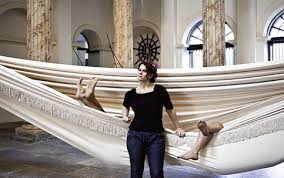
We were lucky enough to have a chance to try out the large hammock-like piece before it was crated and shipped to Austria for a show.
The hammock is going into the crate.
Leaving Neto's studio, I was reminded of the ripple effect an art artifact, idea or artist may have. Neto is partially responsible for one of the most interesting galleries in Rio: Gentil Carioca. Gentil Carioca takes on an unassuming building in the SAARA, very close to Largo das Artes. Their profile is half-way between a commercial art gallery and a non-profit. Gentil Carioca furthers the career of a strong cohort of young Brazilian artists such as Maria Nepomuceno and Laura Lima but also maintains a very unusual initiative, which supports the education of kids in communities that otherwise would not have access to art.
Finally, in the "new generation of Brazilian artist" it's worth mentioning more about the one everyone talks about–also a Carioca—Laura Lima. I did not get to meet her but saw her much discussed piece in the group show "Encruzilhada" (Crossroads) at Parque Lage. The piece is a naked man—tethered to ropes and cords that are anchored to the trees outside and run through the open windows—who, like Sisyphus, painfully struggles about with the dead weight. Lima's performances are a little too didactic too my taste and while they never feature the artist herself, too reminiscent of early performances by Marina Abramovic. But there is one that has just came to my attention this week, as it is about to open in the National Gallery of Denmark. The work, entitled The Naked Magician, is an installation with a performer. It is theatrical and laden with metaphors. I see lots of common threads between her brand and the way I tend to work. Even her slightly didactic but disjoint and layered narratives resonate with me. Lima has a degree in philosophy.
Laura Lima: The Naked Magician
Laura Lima with her two "disinterested observer" performers in the hammock.
Parlor Games: Axioms
Installation with synthetic netting, synthetic hair extensions, natural rubber, tar, asphalt, ceramic tiles, wooden boxes, "Ruby Crystal" plastic plates, porcelain cup, projected digital drawing, printed digital photograph, soil, palm and jackfruit seedlings.
Below is the curator's statement Carla Hermann wrote about the show (my translation):
"I feel like I m stepping into your room. - was my expression of surprise to artist, Timea Tihanyi, at our last meeting. The installation Parlour Games: Axioms by USA-based, Hungarian-born artist that is currently presented at Largo das Artes presents very particular choices that make up her almost enigmatic logic. Resulting from various encounters over the past two months of her residency, the objects and materials Timea chose to include— be those of a result of active production or accidental encounters—are those she has developed an affective connection to, and thus, for her, carry meanings and significances. When looked at more closely, some reveal aspects of our particularly Brazilian history but they are also a reading of otherness that has been experienced by the artist.
In the installation, there are networks made from black hair extensions and disposable transparent red plates and cups in spatial constructions that refer to both kitsch and, at the same time, reminiscent of constructivist and modernist architecture. These materials, including oil by-products that is present in the compressed asphalt discs and the natural rubber, which is cut in the form of colonial architectural adornments, are pregnant with Brazilian social memory.
To the viewer, however, no easy solution is given to the riddle that is the meaning of the entire installation. Instead, the viewer/participant needs to look deeper at the details in the materials and processes in order to understand the connections among the parts, which function as symbols and metaphors. This process leads to the secrets. The reason for the artist not wanting to give us an easy narrative is due to her interest is in the connection (or in the friction in communication) between the visual experience and cognition of the mind. At the end, she wants to find out how the body perceives this constructed space. The installation leaves us free to understand what's in front of us, to perceive the forms, to understand the ways they infer motivations, ultimately unravelling some kind of narrative that is present in the form of a black line (a line of drawing) that runs through the objects placed in the space.
What we have is a puzzle, a sample of the artist’s experience, to which she invites us in a form an unsettlingly non-linear narrative. We feel that we want to understand the steps of her thought-process and to find out how these experiences were made and assimilated into the installation. We want to start to weave explanations, though these become layered and complex, in order to fully realize the truth of her choices. Maybe I was trying to get inside the head of Timea when I said that I seemed to be entering such a particular and personal space as “her room.” And maybe that's the feeling we all feel walking into Parlour Games: Axioms. It is a script of fiction without a narrative as observed by the artist, who in addition to being a university art professor, interestingly, is also trained in neuroscience."
Carla Hermann 2015
I think the term "fiction without a narrative" which was first used in our conversation with curator, Alexandra Sá, is very descriptive of my work in general and of this installation in particular. In addition to calling it "my room" Carla has also called the installation a "black box" (as the ones that keep all the data on airplanes).
Detail of the net with the Kayapo hand. I think of the hand as the hand of the maker, the trickster, the magician. It has a certain power that is beyond logic and with which it is able to transform materials.
In the shadow of the net rests a city made of plastic. It's my ruby red version of the Emerald City from The Wizard of Oz. A formal and conceptual utopia of the city.
It's possible to walk into the installation.
There are many things that are meant to be taken for "real" or "living" in the installation, including the photographic hands and the moving dog. But this one, a live jackfruit seedling I have been growing since early April, and a palm seedling are the only two that are truly real and living. They are a somewhat sentimental but necessary counterpoint to all that is synthetic and symbolic.
A view of the dog: hesitant, jittery. He sits down then stands again, not quite knowing what to do with himself.
Axioms: UTOPIA and DYSTOPIA
My work is always a re-positioning of myself in relationship to something else. In this sense, the work accomplished during the residency is not just about Rio (Brazil) but about my relationship to what I found in Rio. The installation, in my own view, is based on dualisms, the most important of these is the pair of UTOPIA and DYSTOPIA. This mixture of a hopeful idealism and the messy reality is neither new nor unique. In fact, I've seen this in Hungary both during and after the Berlin wall, and now again in all over Europe, as many of the countries are dealing with their of special blend of issues resulting from a collapsing economy, faltering social structure, painful legacies and increasingly inhomogeneous population.
Coming from a Continental intellectual tradition, I had been taught to look for fundamental rules and to make abstractions. This was in the hope of finding a perfect solution, creating a UTOPIA of a general rule that is applicable and will always remain true. Looking from UTOPIA, DYSTOPIA is chaos, it has no place and makes no sense. But reality is most often dystopic. Dystopia is a twisted, adulterated version of the ideal, a place where everything has gone awry but no one is responsible (and none cares or dares to solve it). Seeing from UTOPIA, DYSTOPIA is wrong. Or, so I’ve been taught…
While being here, I came to see Rio as a gigantic dystopia. There are many things that are not right, of course, but there is also sense in the unsettling chaotic mass. There is a certain logic to the illogical situations and many many things that are outside of logic. What I found is that there is not a choice between the two states, but an existence that is in-between the two. That's what I wanted to make the work about.
I'm done with making but I'm not yet finished with the story. I liked that the curators referred to my work as fiction. I will go with that and keep posting more about Brazil. Hopefully, those posts will further shed light on the ideas and sources mentioned above.
Posing with a few artist and mathematician friends at the opening.
I had two research plans for coming to Rio: The first one was to learn more about Neoconcretismo (Neo-concretist art, such as Helio Oiticica and Lygia Clark's work) and about contemporary artist who follow in their footsteps in exploring logical—almost mathematical—constructed systems in experiential and bodily ways.
The second research plan was to look at architecture, especially 20th century modernist architecture. For the past years, I've been making miniature sculptures that started out as nothing more but studies in structural composition but became increasingly inspired by real and imaginary architectures. I've been fixated on 50's architecture in Brazil since watching Flores Raras (Reaching for the Moon), dir. Bruno Barreto.
Panorama from Parque das Ruinas in Santa Teresa. Click on the photo to make it larger.
A quick look down at the metropolis from any of it's high-perched observation points reveals a sea of drab concrete blocks, dotted with red tile roofs, occasional romantic cupolas, squares of green parks and tight vertical patchworks of raw masonry and intense wallpaint color in the favelas.
Rio was discovered on January 1st, 1502 by Portuguese sailor Gaspar de Lemos, who gave it the name, River of January. It did not get settled by the Portugal until 1555 due to turf wars between the native Tamoimo, the French and Portuguese. Jesuits arrived in waves followed by other religious orders, such as the Franciscans, and by the 17th century, Rio was established as the 3rd biggest settlement in Brazil. Millions of slaves from Africa were brought to provide labor for sugar cane plantations and in the newly discovered gold and diamond mines in Minas Gerais, making Brazil the largest of slave holding nations. For rough comparison: Between the 16th and 19th century, North America imported about 600 thousand, while Brazil took almost 5 million people from Africa as forced labor. The turning point in the development of Rio came in the early 1800's when the Portuguese regent prince, Dom João VI, fleeing from Napoleon set up his court in Rio. He eventually became the king of Portugal but being in love with Rio so much, created an exception and ruled from the Colony. The 19th century brought new waves of immigrants not only from Europe but also resulting from internal displacement: veterans from the civil wars, rural population and former slaves from the failed sugar and coffee plantations and from the exhausted mines all came to seek new prospect in the rapidly expanding city. Brazil was the last country to abolish slavery, in 1888. These poor migrant laborers finally set up camp on the steep mountain sides creating somewhat isolated and, as such, autonomous enclaves under extremely rough conditions – this was the birth of favelas.
In the early 1900's Rio continued to expand and modernize, resulting in large scale urban projects such as the expansion to Copacabana. These moves were not trivial: because of the scalloped shoreline and dozens of small mountains that dot the landscape, each expansion required a tunnel or landfill. Early maps reveal a disjointed urban fabric, and this is still true today both geographically and economically. While the government moved to Brasília in 1960, the mid-century saw an even more intense architectural program lead by star architects, such as Oscar Niemeyer, Lucio Costa, Roberto Burle Max, and Affonso Eduardo Reidy. During this time, interior migration to favelas has also intensified resulting in a total of 763 such enclaves by 2011 with an estimated 1.8 million people living in them (that is almost 1 in every 4 people in Rio de Janeiro).
This history shows up everywhere:
Convento de Santo Antônio is the earliest Franciscan convent. In its original form it was completed in 1620. Behind it, the headquarters of Petrogas, Brazil's oil monopoly.
Convento de Santo Antônio is actually 3 different churches built in different styles in different centuries, including the most lavish baroque one, Igreja da Ordem Terceira de São Francisco da Penitência.
View of Centro from Santa Teresa. The main landmarks include Aqueduto da Carioca or also called Aqueduto da Lapa (Lapa aqueduct, built in the middle of the 18th century to bring fresh water from the Carioca river to the city. To the left of the aqueduct is the stunning Catedral Metropolitana de São Sebastião (Metropolitan Cathedral of Rio de Janeiro) designed by Edgar Fonseca, finished in 1979.
Street view of colonial mansions in the Santa Teresa neighborhood. This street used to have a quaint old tram that climbed from the bottom to the top of the hill through Santa Teresa's windy streets.
Street in Santa Teresa. Not obvious from the photo but there are 4 levels of streets in this spot. Each is accessible with a flight of stairs cut directly into the walls (no handrails). Many of the colonial building are in the state of severe disrepair.
Street in Glória, close to Lapa. The city lives on many levels.
Museu de Arte Moderna do Rio de Janeiro (MAM). Located in Flamengo Park, which was one of the mid-century urban planning projects. Flamengo Park was envisioned by landscape architect Roberto Burle Marx with Lota de Macedo Soares, whose life story made the film, Flores Raras. The Modernist concrete museum building, designed by Affonso Eduardo Reidy was completed in 1955.
Museu de Arte Contemporânea de Niterói or MAC (Niterói Contemporary Art Museum) is situated across the bay, in the city of Niterói, Rio de Janeiro. It was designed by Oscar Niemeyer and completed in 1996.
The spiraling walkway that leads up to the entrance is painted red.
The shape is so lovely, makes me think of a Lucie Rie ceramic vessel more than a UFO or a spindle (as the bus driver described it to me with wild hand-gestures).
One of the fancier apartment buildings by the Lagoa (lagoon) in upper middle-class Gavea.
Nicer apartment buildings overlooking the Lagoa on the Ipanema side. On top of the mountain is a scrappy looking concrete monolith. As often is the case, it goes unnamed on the Google map, so I could not figure out what it was. I'm guessing it may be a government (police or military) complex, a school or community center located on the edge of the Cantagalo favela of Copacabana.
This graffiti is on an abandoned building near the ferry terminal in Niteroi. The signage translates: "50 years of military coup" and "Remember and Resist".
This is one of the most upscale neighborhoods, a fancy street in Leblon. From the buildings to the landscaping, everything is well kept, clean and maintained in a sparkly state. The street is empty, scrubbed clean. The trees have orchids growing on them.
So different from the rest of Rio!
Even in middle class neighborhoods such us ours, while the streets are litter free for the most part, there is so much disrepair, broken sidewalks, cheap useless fixes, stench of excrement (with no actual excrement in sight), and a large number of homeless sleeping and living everywhere.