Researching, in their own context, artists significant in modern Brazilian art history, and learning about the contemporary South-American art scene were among the primary aims of my coming to Brazil. Largo das Artes has extensive connections in the Rio artworld and residents are well taken care of with regular recommendations and visits to museums, galleries, openings and other art-related events.
While—contrary to my expectations—I did not get to see any of Lygia Clark's pieces in Rio, I've noticed a strong connection between art and psychotherapy in contemporary art that she had helped to champion. I wonder whether, in fact, this connection is due to the influence of her work or if there is a uniquely Brazilian emphasis on exploring and expressing intangible spiritual dimensions. (While I did not have a chance to see her work here, on the other hand, the recent MoMA exhibit of Lygia Clark's work has an excellent online resource of videos and catalogued artworks.) Clark's later work emphasized sensory perception that is taken out of the exclusive realm of the visual and focused on the psychologically charged interaction between artwork and participant. She has referred to her interactive pieces as ones to create a "ritual without myth."
While Clark has eluded me the whole time (her work is too fragile to be on permanent view and, as I've heard, has also been a subject of disputes between her estate and collections,) I got to learn more details about Helio Oiticica's oeuvre. During his short life Oiticica produced works both experimental and wide-ranging so that his brands of artworks (e.g. Tropicalias, Penetrables, and Parangoles) created a permanent touchtone for contemporary Brazilian art theory, which in turn spurred on a younger generation of artists. His artistic persona and his work has been successfully mythologized under the stewardship of his brothers and the artworld. In the fall of 2015, a documentary made by brother Cesar, on the life of Helio Oitica will be released in New York.
Helio Oiticica: Parangole
There is an extremely strong trend of conceptual art tradition is Brazil that is often connected to living during the military dictatorship. In contemporary art, there is a generation of much revered mature artists, like Antonio Dias, Cildo Mereiles, and José Damasceno, who further a conceptual approach that is simultaneously material orieneted, each making it into his own uniquely different brand. Much to my surprise, Eduardo Kac, the artist of the glow-in-the-dark bunny, Alba, has also come from these conceptual beginnings. Kac's early work, made in Brazil in the early 1980's focused on language, abstraction, and technology. The artifacts of his inquiry into methods of transcription were extremely interesting to see in the Laura Marsiaj Gallery, especially that Eduardo was kind enough to supply detailed explanations about the now obsolete technologies he used for making these pieces. Kac lives and works in Chicago. Meeting him in Rio and listening to his explanations fluidly moving from Portuguese to English was an interesting but oddly confusing experience.
Eduardo Kac in a gallery talk at Laura Marsiaj Gallery.
The same odd out-of-place encounter has happened with author Sarah Thornton, whose new book "O que é um artista?" (What is an artist?) was released in Brazil in April. Thornton gave a talk in Parque Lage to an overflow audience. During the talk, she presented many intriguing stories and artist characters from her book, which is a result of insightful interviews and discussions with her large sample of artist subjects, many of whom she had to pull strings with in order to have this kind candid and exclusive access to. After the talk, I tried to inquire if her findings about what makes an artist were applicable to a much larger population of mainstream and emerging artist, or were they merely "celebrity gossip" we all enjoy but have very little generalizations to make from. We had an interesting but non-conclusive conversation about this. Since then, I had a chance to read the book, which I find very thoughtful and well researched, yet still a bit in the realm of quality entertainment rather than something I would assign to my students.
If there was one artist I really had wanted to meet in Rio, that would have to be Ernesto Neto, whose room size installation at the Henry Art Gallery, entitled the Flying Gloup Nave, was a formative experience during my gradschool years. His work had opened up an entire world of possibilities about sculpture that is both object-like/bodily and spatial/architectural; both sensual as well as completely trivial (I should have used the words accessible or domestic here). I liked the fact that his work was made on a scale of a building but with materials and processes that are assigned to the feminine: thousands of little stitches, threads and connections, elastic surfaces that could be pulled, stretched and expanded.
In early May, the wonderful Casa Daros held a "bate-papo" (chat) with Neto, which gave me the first chance to meet him. After sitting through two hours of meandering stories in his animated Portuguese that ranged from his becoming an artist (through astronomy) to his ideas about education (movement and dance instead of book-learning); from Brancusi's Kiss to criticizing FIFA—in much of this I only understood what the story was about but not the actual details of how it went—I had a chance to introduce myself and have a brief chat. I learned that his 2006 exhibition in the 'le Panthéon', Paris was made in the space that is my studio in Largo das Artes.
A fan-picture with Ernesto after his lecture.
Embraced by a Neto sculpture in Casa Daros.
A few weeks later, with Largo director, Miguel Sayad's help, we were to visit Neto's atelier, also located in the Centro, a few blocks away from our studio. His workshop takes up a three-story building and it functions more-or-less like a factory. Stairs separate the prep and install areas (ground floor) that have many workers, from the sewing and storage rooms (middle level) that only have a few specialized assistants, finally arriving to Neto's private space (on top floor). The studio building is both magical and completely down-to-earth practical. There are lots of video-interviews available online in which Neto speaks about the work that goes on and the workers he employs from the favela communities. Although this question was not raised during our conversation, I found him to be genuinely interested in the betterment of his community and in the social, emotional and cultural well-being of Brazilian society in general. Our discussion lasted about an hour and was somewhat strange. Somehow most of the discussion revolved around indigenous spiritual traditions, many of which Neto is both interested in and, apparently, practices. I've noticed before that the use of certain psychotropics is widely condoned in Brazil, as a way of both accepting the indio heritage of using plant substances for making a connection with nature and the spiritual realms, and also as a way of accessing one's own otherwise unreachable psychic dimensions. To my question about what he thinks of the critical discourse around his work (since I've never see the ideas he mentioned anywhere in the writings of curators and art critics), the artist said that he nearly never reads these, or when he does much later, he tends to ignore them. Even if this was an exaggeration, he seemed to imply that his work springs from a completely introverted origin, one that is very personal to him and thus can exists in such isolation. He seemed to say that when people find a way to relate to his work it amuses him, but does not affect or feed his process, which exists only for his own reasons. I find this self-centered certainty to be an admirable model to follow.
The entry to the second floor is shaped like the characteristic orifices.
Ground floor was turned into a dye studio just a few weeks before, in order to complete a project.
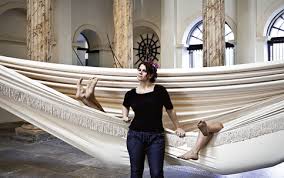
We were lucky enough to have a chance to try out the large hammock-like piece before it was crated and shipped to Austria for a show.
The hammock is going into the crate.
Leaving Neto's studio, I was reminded of the ripple effect an art artifact, idea or artist may have. Neto is partially responsible for one of the most interesting galleries in Rio: Gentil Carioca. Gentil Carioca takes on an unassuming building in the SAARA, very close to Largo das Artes. Their profile is half-way between a commercial art gallery and a non-profit. Gentil Carioca furthers the career of a strong cohort of young Brazilian artists such as Maria Nepomuceno and Laura Lima but also maintains a very unusual initiative, which supports the education of kids in communities that otherwise would not have access to art.
Finally, in the "new generation of Brazilian artist" it's worth mentioning more about the one everyone talks about–also a Carioca—Laura Lima. I did not get to meet her but saw her much discussed piece in the group show "Encruzilhada" (Crossroads) at Parque Lage. The piece is a naked man—tethered to ropes and cords that are anchored to the trees outside and run through the open windows—who, like Sisyphus, painfully struggles about with the dead weight. Lima's performances are a little too didactic too my taste and while they never feature the artist herself, too reminiscent of early performances by Marina Abramovic. But there is one that has just came to my attention this week, as it is about to open in the National Gallery of Denmark. The work, entitled The Naked Magician, is an installation with a performer. It is theatrical and laden with metaphors. I see lots of common threads between her brand and the way I tend to work. Even her slightly didactic but disjoint and layered narratives resonate with me. Lima has a degree in philosophy.
Laura Lima: The Naked Magician
Laura Lima with her two "disinterested observer" performers in the hammock.
It's like as if the Jardini of the Venice Biennale moved to the tropics, got more color, more polish and a much more cutting edge architectural style, and was lavishly dressed for a wedding. I've been told repeatedly that one couldn't be an artist in Brazil and not visit Inhotim. Some local friends have called it a pilgrimage that one has to make before dying and I've also heard it unflatteringly nicknamed as the Disneyland of the artworld. All of above are true together.
It's a magnificent and magical place, an artist geek-out in the middle of "nowhere" in rural Minas Gerais (MG), a state northeast of the state of Rio de Janeiro. It's an hour flight from Rio to Belo Horizonte, the capital of MG, plus another 2 hours drive on badly marked, insanely rolling rural roads. It took both of us to navigate these roads, in addition to a rental car GPS and many carefully selected printed google maps (thanks to Sandor's excellent planning) that showed every possible intersection and turn to be encountered.
As a gift for my birthday, we took a 3-day trip to MG, visiting the historic town of Ouro Preto, the Serra de Moeda mountain range, and Instituto Inhotim.
According to their website, "Instituto Inhotim began to be conceived in the mid-1980s by Minas Gerais businessman, Bernardo de Mello Paz. With time, this parcel of private land was transformed into a unique place, with one of the most significant collections of contemporary art in the world and a botanical collection containing rare species from every continent." Paz commissioned architects and landscapers for making "temples" for the significant artworks that were already in his collection, as well as over the years he has continued to commission many more of the leading contemporary artists for making site-specific works, many of which enjoys the benefit of a close collaboration between artist, architect and landscape architect. The result is a mind-blowing exploration of space and the senses, the visual just being a tiny fraction of this equation.
A long palm-lined path leading up to the entrance of Inhotim.
Groundkeeper at work in the magical landscape of tropical colors and textures. Among the trees, there are hundreds of hidden sites for resting. Clever nooks landscaped from plants, rocks and roughly carved tree trunks provide well-disguised shelters for a quiet enjoyment of the park.
The pavilions and the surrounding landscape are custom designed for each of the artworks; often in a close dialogue between artist and architect. This striking red and white space is housing True Rouge by Tunga.
Matthew Barney's De Lama Lâmina (Mud Slide) in its geodesic glass dome.
Each pavilion deserves not only to bevisited but to be carefully and meticulously explored. Delicious architectural surprises await on rooftops, in corners, passageways, and even in the minute lunchbars that are part of some buildings. The artworks are showcased, celebrated, and made love to by the architecture. For example, Janet Cardiff's two sound installations are overwhelming and momentous in their cavernous but otherwise empty halls. One can make out in a hammock while slides flash through and Jimmy Hendrix is playing or take a dip in a dimly lit swimming pool while listening to John Cage in one of Helio Oiticica's Cosmococa environments. (Do your part to erase the division between art and life!) Smell the flowers, or better yet, plant them in Marilá Dardot's installation, Origem da Obra de Arte; listen to the belly of the Earth growling 200 meters deep in Doug Aitken's Sonic Pavilon or be shaken to the bone by the darkness emitting from the photographs, installations and corten walls of the pitch-black galleria Miguel Rio Branco. The exploration of the park is a step-by-step process, and there is a great joy in not knowing what is up next. Inhotim is simply insane, and it is impossible to put into words or present through a few badly composed photos taken from the outside (the Institute forbids taking pictures of the artworks inside of the buildings). Inhotim is simply a must see. It takes two days to get through it and it could possibly take a whole week to leisurely and fully enjoy every bit of what the park offers.
Helio Oiticica's Magic Square #5 is a proposition for blurring the division between sculpture, painting and architecture, between space and object.
Pavilion designed to house one of the major works by Lygia Pape, Ttéia 1C.
Paying homage to the artist, not only the walls make a 30degree twist between the square of the floor and that of the roof, but the passage way between the entrance and the gallery is shaped like it could be one of her characteristic geometric forms.
Here is a blurry photo of the piece itself. The whole thing is made of nothing more but lights and metallic threads. It is mesmerizing and breathtaking.
Olafur Eliasson's Viewing Machine
The inside of Olafur Eliasson's Viewing Machine
Marilá Dardot's participatory work in which visitors can plant seeds in letter-shaped pots and place them out in the pasture. This sign must have said "Obrigada Deus" (Thank you, God.) until the R and the U were pirated by other participants.
Some of my favorite flowers from the park (I don't know any of their names... I have about ten times as many photos of plants that I took.)
We toasted my birthday on the "top of the world" in the Serra Moeres mountains.
The amazing view from our window of the fog slipping through the valley at 6:30am in the morning. Inhotim is at the opposite end of the valley, about 35Km, 1 hour driving away.
En route to Inhotim, we stopped for a day in Ouro Preto, the center of gold and silver mines in the 18th century. This city was made rich with gold that was mined from its mountains, washed from its rivers and picked from its land. Lavish architecture was comissioned by the Portuguese, which is well preserved due to the city's status as one of the World Heritage sites. Ouro Preto (Black Gold) is a marked contrast to the dirty, ignored, run-down, unhealthy cities and villages that are a majority in Brazil.
View of Praça Tiradentes (the main square) in the Center of Ouro Preto.
This may be the steepest incline that any street on this earth has. The sidewalk (aka the narrow catwalk by the houses) has many steps to prove it. The road itself is barely passable. While climbing up, we met a car which was driving down. It was 1degree away from free fall.
Igreja S. Fco. Assis (Church of Saint Francis of Assisi)
Ceiling fresco in the Church of Saint Francis of Assisi. The style and symbolism is very particular to this area of Brazil. The combination of reds and blues make all the decorations quite lovely. There are expressive hand and facial gestures and Christ is often symbolized with a pair of crossed (wounded) hands placed over a heart.
The fountain in the back of a garden. Notice the decoration of broken plates and seashells and the blue color.
I had two research plans for coming to Rio: The first one was to learn more about Neoconcretismo (Neo-concretist art, such as Helio Oiticica and Lygia Clark's work) and about contemporary artist who follow in their footsteps in exploring logical—almost mathematical—constructed systems in experiential and bodily ways.
The second research plan was to look at architecture, especially 20th century modernist architecture. For the past years, I've been making miniature sculptures that started out as nothing more but studies in structural composition but became increasingly inspired by real and imaginary architectures. I've been fixated on 50's architecture in Brazil since watching Flores Raras (Reaching for the Moon), dir. Bruno Barreto.
Panorama from Parque das Ruinas in Santa Teresa. Click on the photo to make it larger.
A quick look down at the metropolis from any of it's high-perched observation points reveals a sea of drab concrete blocks, dotted with red tile roofs, occasional romantic cupolas, squares of green parks and tight vertical patchworks of raw masonry and intense wallpaint color in the favelas.
Rio was discovered on January 1st, 1502 by Portuguese sailor Gaspar de Lemos, who gave it the name, River of January. It did not get settled by the Portugal until 1555 due to turf wars between the native Tamoimo, the French and Portuguese. Jesuits arrived in waves followed by other religious orders, such as the Franciscans, and by the 17th century, Rio was established as the 3rd biggest settlement in Brazil. Millions of slaves from Africa were brought to provide labor for sugar cane plantations and in the newly discovered gold and diamond mines in Minas Gerais, making Brazil the largest of slave holding nations. For rough comparison: Between the 16th and 19th century, North America imported about 600 thousand, while Brazil took almost 5 million people from Africa as forced labor. The turning point in the development of Rio came in the early 1800's when the Portuguese regent prince, Dom João VI, fleeing from Napoleon set up his court in Rio. He eventually became the king of Portugal but being in love with Rio so much, created an exception and ruled from the Colony. The 19th century brought new waves of immigrants not only from Europe but also resulting from internal displacement: veterans from the civil wars, rural population and former slaves from the failed sugar and coffee plantations and from the exhausted mines all came to seek new prospect in the rapidly expanding city. Brazil was the last country to abolish slavery, in 1888. These poor migrant laborers finally set up camp on the steep mountain sides creating somewhat isolated and, as such, autonomous enclaves under extremely rough conditions – this was the birth of favelas.
In the early 1900's Rio continued to expand and modernize, resulting in large scale urban projects such as the expansion to Copacabana. These moves were not trivial: because of the scalloped shoreline and dozens of small mountains that dot the landscape, each expansion required a tunnel or landfill. Early maps reveal a disjointed urban fabric, and this is still true today both geographically and economically. While the government moved to Brasília in 1960, the mid-century saw an even more intense architectural program lead by star architects, such as Oscar Niemeyer, Lucio Costa, Roberto Burle Max, and Affonso Eduardo Reidy. During this time, interior migration to favelas has also intensified resulting in a total of 763 such enclaves by 2011 with an estimated 1.8 million people living in them (that is almost 1 in every 4 people in Rio de Janeiro).
This history shows up everywhere:
Convento de Santo Antônio is the earliest Franciscan convent. In its original form it was completed in 1620. Behind it, the headquarters of Petrogas, Brazil's oil monopoly.
Convento de Santo Antônio is actually 3 different churches built in different styles in different centuries, including the most lavish baroque one, Igreja da Ordem Terceira de São Francisco da Penitência.
View of Centro from Santa Teresa. The main landmarks include Aqueduto da Carioca or also called Aqueduto da Lapa (Lapa aqueduct, built in the middle of the 18th century to bring fresh water from the Carioca river to the city. To the left of the aqueduct is the stunning Catedral Metropolitana de São Sebastião (Metropolitan Cathedral of Rio de Janeiro) designed by Edgar Fonseca, finished in 1979.
Street view of colonial mansions in the Santa Teresa neighborhood. This street used to have a quaint old tram that climbed from the bottom to the top of the hill through Santa Teresa's windy streets.
Street in Santa Teresa. Not obvious from the photo but there are 4 levels of streets in this spot. Each is accessible with a flight of stairs cut directly into the walls (no handrails). Many of the colonial building are in the state of severe disrepair.
Street in Glória, close to Lapa. The city lives on many levels.
Museu de Arte Moderna do Rio de Janeiro (MAM). Located in Flamengo Park, which was one of the mid-century urban planning projects. Flamengo Park was envisioned by landscape architect Roberto Burle Marx with Lota de Macedo Soares, whose life story made the film, Flores Raras. The Modernist concrete museum building, designed by Affonso Eduardo Reidy was completed in 1955.
Museu de Arte Contemporânea de Niterói or MAC (Niterói Contemporary Art Museum) is situated across the bay, in the city of Niterói, Rio de Janeiro. It was designed by Oscar Niemeyer and completed in 1996.
The spiraling walkway that leads up to the entrance is painted red.
The shape is so lovely, makes me think of a Lucie Rie ceramic vessel more than a UFO or a spindle (as the bus driver described it to me with wild hand-gestures).
One of the fancier apartment buildings by the Lagoa (lagoon) in upper middle-class Gavea.
Nicer apartment buildings overlooking the Lagoa on the Ipanema side. On top of the mountain is a scrappy looking concrete monolith. As often is the case, it goes unnamed on the Google map, so I could not figure out what it was. I'm guessing it may be a government (police or military) complex, a school or community center located on the edge of the Cantagalo favela of Copacabana.
This graffiti is on an abandoned building near the ferry terminal in Niteroi. The signage translates: "50 years of military coup" and "Remember and Resist".
This is one of the most upscale neighborhoods, a fancy street in Leblon. From the buildings to the landscaping, everything is well kept, clean and maintained in a sparkly state. The street is empty, scrubbed clean. The trees have orchids growing on them.
So different from the rest of Rio!
Even in middle class neighborhoods such us ours, while the streets are litter free for the most part, there is so much disrepair, broken sidewalks, cheap useless fixes, stench of excrement (with no actual excrement in sight), and a large number of homeless sleeping and living everywhere.