Wednesday, June 3, 2015

Cosmology made with a line: Where do axioms come from?

The past two-three weeks have been largely devoted to intense and instinctual making, which barely left time for thinking, let alone for writing. Now, on a post-residency slumber in Cabo Frio, I have a chance to think through past events and articulate my so far only vaguely expressed ideas with the benefit of distance, as well as to compile documentation from this last big project.
On Thursday, May 28th the studios at Largo das Artes opened again for an exhibition. As a summing up of my residency, I created an installation to both reflect on and to make sense of my experience of Brazil. The idea of the project came to me almost at once, seeing the main components in my head in a sudden burst of insight. At first, I had no idea why these parts had to be together but I was certain of their necessity. Many of the smaller details came and left during the weeks of making; the process of dumping everything into the space (making a "glorious mess") was an exhilarating riddle of potentials, after which eliminating pieces in order to solidify the whole became a painful but absolutely necessary exercise.
Given the short deadline to finish, even leading up to the exhibition, I was certain that the ideas that arose would require more time to be refined and made sense of, time that I will only have once back in my own studio. So I was thinking about the installation as a sketch version of a piece that will be finalized later. But, as I was actually putting on the finishing touches, it became clear to me that this—just like any other installations I've made—is a one-off. It is tied to the place and the experience, I can't, don't need to and I probably wouldn't be remaking.

The next few images are early "undigested" versions of the installation. There is a lot more in here, including text, a firehose and various material studies that were interesting but never made the connections to the other parts.
Testing various ways of presenting the dog. 
I really wanted to use the cut vinyl piece from last month but it was too delicate and it did not feel right. At the end, it had to go. 
This early version in which the shadow and the objects together make a black and white drawing is also interesting. 
Many things, like this material study made from the super-cool find of a thrown away firehose never made it. In fact, one of my biggest regrets with the residency was that I could not find a good enough idea to make something worth making out of the firehose. 
I discovered this shop devoted exclusively to selling styrofoam forms and figurines only too late. Sadly, at that point, there was no place any more in my universe for these amazing kitsch objects.
The residency provided an enormously helpful opportunity to have the insight of two curators, Carla Hermann and Alexandre Sá on my work. It's such a rare chance to have someone to add their thoughts to mine during the making process. Both Carla and Alexandre contributed not with critique or concern (like it has become a practice of necessity for me when trying to keep student projects on track) but instead with an interesting perspective to add from the viewpoint of an outsider (with regard to my work), who is also an insider (with regard to the culture the work seeks to establish some kind of relationship to).

So given the number of images and the lengthy narrative that goes with the work, I'll be making two entries related to the installation. This first one explains the materials and how they had come into the work, as well as why they've never left. Here we go:

Materials:
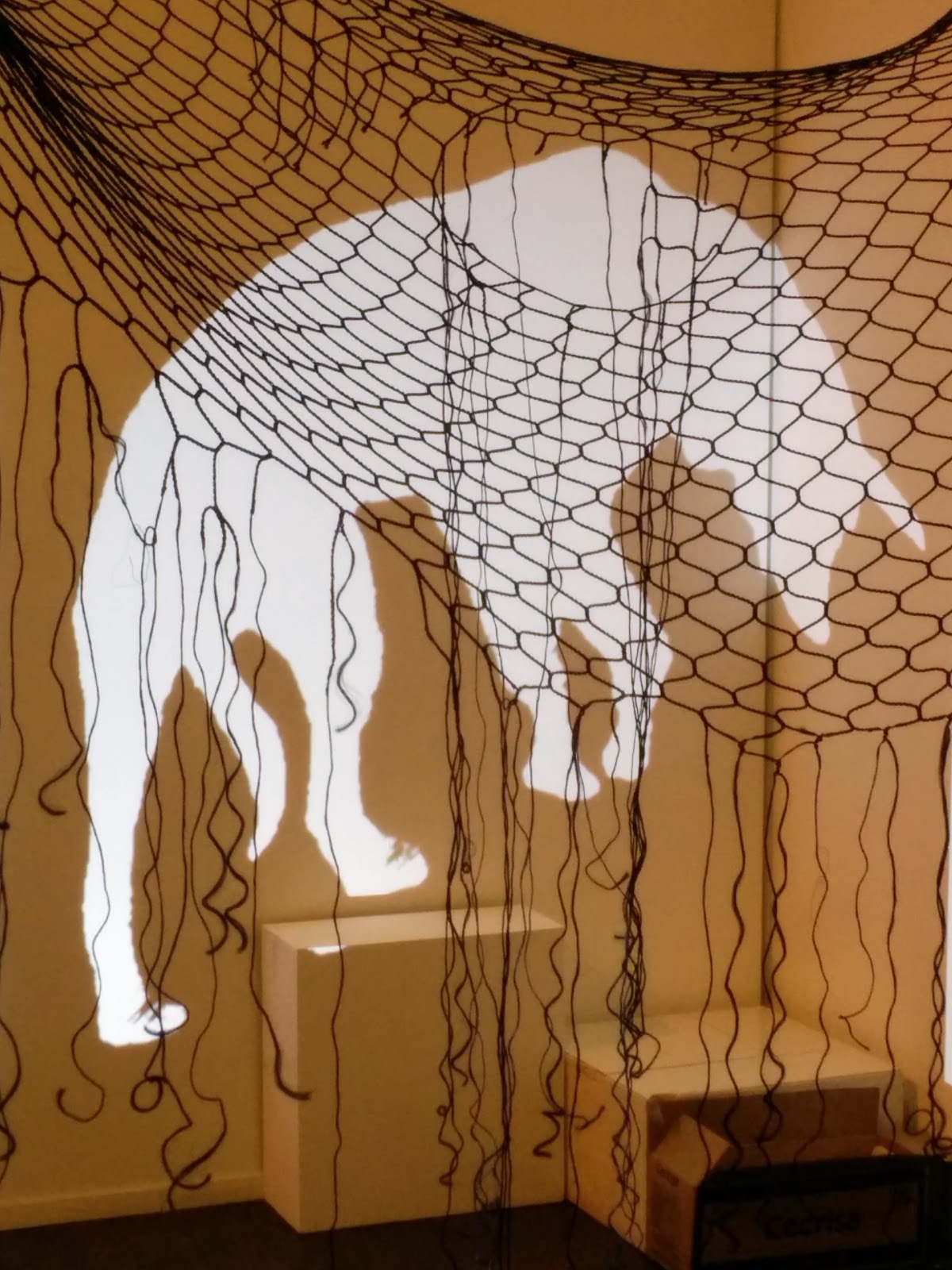
Net and hair extensions: These two came hand in hand in my almost photo-quality moment of insight. The net is unravelling into threads of hair, ...or the is hair woven into a net? They are both black, creating another subtheme for the installation: black drawing on white surfaces. Both net and hair are synthetic. Their artificial nature is important; made with the same kind of plastic, they add another aspect of make-believe to the scene. The net is both a barrier, a soft version of the ubiquitous fences and zones of demarcation in Rio that separate the have's from the have-not's, but it is also a protective canopy that spans over and beyond the entire scene.
I started with hanging the net and later adding the hair extensions to it. This process opened and closed spaces and later on allowed me to play with the tensions. 
In a few weeks I've attached hair to all the ends, making a much larger net. This picture was taken before the net was raised into place. 
Claire, Fred and Anton are installing lights for Claire before the night before the opening.  The ceilings at Largo das Artes are very high with barely any support or place for the ladder, making the suspension of anything a real areal feat. I could not have put up this installation without the help of Anton, Pablo and Consuelo.  
Hands: Drawing became an important theme for me since having a chance to watch an artist from the Kayapo tribe applying paint on someone's body. Her hands were covered with paint that is a mixture of charcoal and some kind of tree-sap. Kayapo drawings are a mind-boggling puzzle of linear geometry. These encompass what seems like an entire cosmology, marking and thus placing the individual according to her/his lineage, characteristics and, possibly, fate.
Kayapo women making a body painting. Kayapo designs are very linear, and typically based on parallel lines that sprawl the entire body, including the face.
A page from the book Grafismo Indígena (Indigenous graphics) edited by Lux Vidal. These Nhiakrekampin drawings of animals inspired the idea of incorporating animals in the form of a drawing into the installation. 
Dog: I first met the dog when helping fellow residenct, Martha Ferracin with her public project out on the square. The dog is a homeless dog, a companion of the many homeless people who live and sleep on Largo do São Francis, in front of our studios. Nicknamed Thintail, he comes and goes in a trusting, somewhat stupidly optimistic way, sometimes laying down in the middle of the square only to be awakened by passersby with probing kicks. There could be lots of animals to represent Rio (and I'd considered a variety of birds, monkeys, and even cows) but Thintail is what for me represents the easygoing manner of the people I've met. His predicament is also in some sense a version of mine, both of us are without a home and making one from what is around.
The Real Thintail.
A test version of Thintail created as a white light, a projected animation. 
I love the way the form fills the space and puts the other objects in relationship with the projection but this test version of the black dog did not go forward because it diverted the meaning of the dog too much. 
Petting Thintail's head with Kris Barz, who helped to translate my animated movement sequence into a line-drawing with his tablet. I then made the still frames into the finished version of the animation.
Asphalt and tar: In contrast to the gold map piece I made during the first month of the residency, I was interested in black as a color that could be equally associated with the opulence of the colonial baroque and with the afro and indigenous cultures that create such a large part of Brazilian heritage. Black is also a color of oil, a natural resource that has made, and if it was not for the corrupt management, could still make the country rich.
These compressed asphalt discs undergo weight and pressure test in the lab. I was able to bring the discs back to the studio and use them in my project. The tar that is in the little container was also given to me by the bemused technicians. Tar becomes liquid at temperatures above 200degrees celsius. As kids in Hungary, we used to pick out the congealing tar from the gaps of the fresh pavement and made little sculptures with it. 
Various aggregates (sand, small gravel and crushed rock) is waiting to be added to the asphalt/bitumen which is a byproduct of oil refining and commonly referred to as "tar."
With the help of Carla Hermann, who, in her formal career worked for the city as a geographer, I've made connections with a civil engineer and arranged to visit to to one of the municipal asphalt companies, Usina de Asfalto Caju. The visit sounded adventurous, especially that neither Carla nor I knew Leonardo, the engineer. As often is the case in Brazil, the connection was made online and our date was arranged for a pick-up at one of the metro stations in the north suburbs. The asphalt company is located by the harbor, nestled in with one of the most neglected neighborhoods. Considering the location, Leonardo has offered to drive us to the facility and led us around introducing the labs (where they test the resilience of the compressed tar, sand and gravel mixture that makes up asphalt) and the actual mixing facilities.
Carla and Leonardo discussing the process of asphalt making. 
The giant mixer of the Caju asphalt plant.
The people who live right next door to the plant hang laundry. The air is very polluted with silica and dust. We, as guests were given dust masks, but no one else at the plant seemed to wear them.
Rubber: With some careful looking one can discover real treasures among the droves of cheap plastics in the SAARA. Natural rubber was such a discovery for me. It comes on meter-wide rolls, in a variety of thicknesses. Differently from the vinyl sheets that may look the part, natural vulcanized rubber is surprisingly supple yet very heavy, which gives it the weight of a limp body. Tough against abrasion but quite fragile to tear and can be easily cut. The color is deep black with just enough natural sheen to be seductive. Vulcanizing (a chemical process that creates polymers using sulphur) gives rubber resilience, the color and the smell.
Rubber tree in the Jardim Botanico.
Installation in an early, work in progress stage. The designs that are on the wall are cut from rubber. In the final version they are on the ground. 
Ornamental colonial designs seen everywhere in the ironwork of gates, windows and railings have been an interesting contrast to the simple rhythm of Kayapo drawings.
Ceramic tiles and plastic plates: In Parallax, I used stacked porcelain plates as both a metaphor for a precarious balance and as interesting sculptural forms. I like that they are both domestic, i.e. familiar, and also somewhat secretive and mysterious when stacked or upturned one on the other. I discovered these "Ruby Crystal" plastic plates in the store that sells party supply. Drawn to their jewel like transparency and the color, I picked up a set of various sizes. In the studio they became futuristic looking building structures, (for me) very much embodying the constructivist/modernist utopia of architecture. As I wrote before, this architecture was one of the first things I knew about Brazil from my research. They represent both functionalism and an idealism that is very particular to the 50's and 60's Brazil but still has an effect on the modern mindset.  The materiality of the white ceramic tiles is a counterpoint to that of the cheap plastic. They are also ubiquitous in Rio's homes, since coming from the beach one needs to have a quick way to rinse the sand off of their feet. They also help to unify the floor with the rest of the space.

Some of the constructions from an early version of the installation.
Finally, about the title:The installation shares many aspects (theatricality, metaphors, a hand that does some kind of a trick, a play with materials in which many things are not what they seem to be, a central animal character that is my alter-ego, projection, soft and hard sculptures, scale-shifts, etc...) with the installation Parlor Games: Parallax I made for the University of Puget Sound's Kittredge Gallery in the winter. I've planned Parlor Games to have three iterations, each exploring a certain aspect of the same subject: the process of knowledge through direct experience and through a mental process of abstraction. I arrived at the formal ties between the new installation and the old one rather unconsciously. When the time came to name the installation I was still somewhat hesitant to cement the connection between the two, settling on Parlor Games: Axioms after considerable hesitation.
I love the word. It's especially meaningful to me and was not sure if it could be applied to such a specific idea or that I should wait and use it at some later time. I love the idea of axioms. They play a large part in my making processes in the form of simple rules and starting points that are given and do not change. With our mathematician friends, I enjoy taking about mathematical axioms, constantly inquiring what they are, how they had come about and whether or not they hold true. Seems like there should be things that are fundamental and unchanging, on the other hand, their existence is also a difficult proposition to accept. I love axioms and I hate them. I need them and I fight them. There are axioms in not only in math but everywhere else in the world: in societies, in cultures, in philosophies, in the way we each live our lives. I don't know if I've managed to say anything new about them, but, at the end, this new iteration of Parlor Games has enough in it for me to call it Axioms.

Sunday, May 17, 2015

Visiting Art-Heaven: Inhotim

It's like as if the Jardini of the Venice Biennale moved to the tropics, got more color, more polish and a much more cutting edge architectural style, and was lavishly dressed for a wedding. I've been told repeatedly that one couldn't be an artist in Brazil and not visit Inhotim. Some local friends have called it a pilgrimage that one has to make before dying and I've also heard it unflatteringly nicknamed as the Disneyland of the artworld. All of above are true together. 
It's a magnificent and magical place, an artist geek-out in the middle of "nowhere" in rural Minas Gerais (MG), a state northeast of the state of Rio de Janeiro. It's an hour flight from Rio to Belo Horizonte, the capital of MG, plus another 2 hours drive on badly marked, insanely rolling rural roads. It took both of us  to navigate these roads, in addition to a rental car GPS and many carefully selected printed google maps (thanks to Sandor's excellent planning) that showed every possible intersection and turn to be encountered. 
As a gift for my birthday, we took a 3-day trip to MG, visiting the historic town of Ouro Preto, the Serra de Moeda mountain range, and Instituto Inhotim.

According to their website, "Instituto Inhotim began to be conceived in the mid-1980s by Minas Gerais businessman, Bernardo de Mello Paz. With time, this parcel of private land was transformed into a unique place, with one of the most significant collections of contemporary art in the world and a botanical collection containing rare species from every continent." Paz commissioned architects and landscapers for making "temples" for the significant artworks that were already in his collection, as well as over the years he has continued to commission many more of the leading contemporary artists for making site-specific works, many of which enjoys the benefit of a close collaboration between artist, architect and landscape architect. The result is a mind-blowing exploration of space and the senses, the visual just being a tiny fraction of this equation.

A long palm-lined path leading up to the entrance of Inhotim. 
Groundkeeper at work in the magical landscape of tropical colors and textures.  Among the trees, there are hundreds of hidden sites for resting. Clever nooks landscaped from plants, rocks and roughly carved tree trunks provide well-disguised shelters for a quiet enjoyment of the park.
The pavilions and the surrounding landscape are custom designed for each of the artworks; often in a close dialogue between artist and architect. This striking red and white space is housing True Rouge by Tunga. 

Matthew Barney's De Lama Lâmina (Mud Slide) in its geodesic glass dome. 
Each pavilion deserves not only to be visited but to be carefully and meticulously explored. Delicious architectural surprises await on rooftops, in corners, passageways, and even in the minute lunchbars that are part of some buildings. The artworks are showcased, celebrated, and made love to by the architecture. For example, Janet Cardiff's two sound installations are overwhelming and momentous in their cavernous but otherwise empty halls. One can make out in a hammock while slides flash through and Jimmy Hendrix is playing or take a dip in a dimly lit swimming pool while listening to John Cage in one of Helio Oiticica's Cosmococa environments. (Do your part to erase the division between art and life!) Smell the flowers, or better yet, plant them in Marilá Dardot's installation, Origem da Obra de Arte; listen to the belly of the Earth growling 200 meters deep in Doug Aitken's Sonic Pavilon or be shaken to the bone by the darkness emitting from the photographs, installations and corten walls of the pitch-black galleria Miguel Rio Branco. The exploration of the park is a step-by-step process, and there is a great joy in not knowing what is up next. Inhotim is simply insane, and it is impossible to put into words or present through a few badly composed photos taken from the outside (the Institute forbids taking pictures of the artworks inside of the buildings). Inhotim is simply a must see.  It takes two days to get through it and it could possibly take a whole week to leisurely and fully enjoy every bit of what the park offers. 

Helio Oiticica's Magic Square #5 is a proposition for blurring the division between sculpture, painting and architecture, between space and object.  
Pavilion designed to house one of the major works by Lygia Pape, Ttéia 1C.
Paying homage to the artist, not only the walls make a 30degree twist between the square of the floor and that of the roof, but the passage way between the entrance and the gallery is shaped like it could be one of her characteristic geometric forms.
Here is a blurry photo of the piece itself. The whole thing is made of nothing more but lights and metallic threads. It is mesmerizing and breathtaking. 
Olafur Eliasson's Viewing Machine
The inside of Olafur Eliasson's Viewing Machine
Marilá Dardot's participatory work in which visitors can plant seeds in letter-shaped pots and place them out in the pasture. This sign must have said "Obrigada Deus" (Thank you, God.) until the R and the U were pirated by other participants.
Some of my favorite flowers from the park (I don't know any of their names... I have about ten times as many photos of plants that I took.)


We toasted my birthday on the "top of the world" in the Serra Moeres mountains. 
The amazing view from our window of the fog slipping through the valley at 6:30am in the morning. Inhotim is at the opposite end of the valley, about 35Km, 1 hour driving away. 
En route to Inhotim, we stopped for a day in Ouro Preto, the center of gold and silver mines in the 18th century. This city was made rich with gold that was mined from its mountains, washed from its rivers and picked from its land. Lavish architecture was comissioned by the Portuguese, which is well preserved due to the city's status as one of the World Heritage sites. Ouro Preto (Black Gold) is a marked contrast to the dirty, ignored, run-down, unhealthy cities and villages that are a majority in Brazil. 
View of Praça Tiradentes (the main square) in the Center of Ouro Preto. 

This may be the steepest incline that any street on this earth has. The sidewalk (aka the narrow catwalk by the houses) has many steps to prove it. The road itself is barely passable. While climbing up, we met a car which was driving down. It was 1degree away from free fall.
Igreja S. Fco. Assis (Church of Saint Francis of Assisi)
Ceiling fresco in the Church of Saint Francis of Assisi. The style and symbolism is very particular to this area of Brazil. The combination of reds and blues make all the decorations quite lovely. There are expressive hand and facial gestures and Christ is often symbolized with a pair of crossed (wounded) hands placed over a heart. 
The fountain in the back of a garden. Notice the decoration of broken plates and seashells and the blue color. 


Dar Uma Palavra. Ter Uma Palavra. (Give a Word. Have a Word.)

Dar Uma Palavra. Ter Uma Palavra. (Give a Word. Have a Word.) Documentation of the participatory word exchange project at Largo das Artes, May 12th 2105.

I've been fascinated with the Portuguese language since arriving to Brazil. In particular, with the sing-songy dialect of Brazilian Portuguese spoken in Rio. I regret now not having the time for classes in advance, which would have prepared me with an understanding of the grammar and syntax. But learning on the fly has been fun, especially that (thanks to smart phones and translator apps) help is always at hand. I made best friends with the soft female voice of the text-to-speech translator app from which I learned my pronunciation and, in the studio, I rely constantly on the aid of Brazilian artist friends. Many of them had been living or studying abroad for years or, in the case of the younger ones (being part of the fully connected Millennial generation) have learned fluent English through the Internet. 
Outside of a small circle of travelled or business people, very little English is spoken in Brazil. For this reason, I had decided early to try to communicate in Portuguese as much as possible, only reverting to a feeble voiced "Você fala Inglês? Eu não falo Português." when the conversation situation gets really confusing. 

In the first week of our stay, I was dispatched to our neighborhood drinking water store (armed with a cheat-card of possible sentences that I had made beforehand) to place an order for a home delivery of a replacement wanter tank. (Unless the home has a water filter system, potable water in Rio, sadly, comes from the store in a 20 liter plastic tank.) Five weeks later, I participated in a day-long workshop on Places and the City lead by artists Gustavo Ciriaco and Fernanda Eugenio and attended a two-hour "bate-papo" (chit-chat) with Ernesto Neto (all in Portuguese). Yesterday, I made my first phone call. I still can't muster more than a baby-talk but understand enough to get by and able to comprehend a large percentage of almost any kind of printed information (thanks to other Latin languages I had encountered).

During the participatory project, "Dar Uma Palavra. Ter Uma Palavra." participants not only explain the meaning of the word to me but also patiently correct my pronunciation. The conversations are in Portuguese or, rarely, bi-lingual and most people curiously flip through the log to see the words given by others and to discuss what words they like and why. 
A page from the logbook showing some of the words received. 
Back in Seattle, I had a project idea for some kind of an exchange to be done in Rio that would take place in the public space. With the students of my Art and Social Practice class, we always close the quarter with a project that asks them to learn a forgotten skill and not only to make some kind of a gift with it, but also to document and present their learning process with the purpose of transmitting the making skill to the rest of us. It's a very popular project, and when taken seriously, it results in a great deal of information acquired and in a "white elephant exchange" of the resulting gifts. This gave me the idea for the initial plans for a participatory exchange project in Rio. There are lots of makers here. Many of them conduct their craft on the street: from caning chairs to cooking food. 
For many weeks, I was looking for both a way and a place to exchange various kinds of skills with the public but could not find a simple method for doing it. Slowly, it has become apparent that language itself should be the subject and the material of such exchange. I would be both the transmitter and the beneficiary of words passed on and acquired.  
I act as a scribe, a relay, while everyone who participates by giving a word would also become a receiver. Each card handprinted with the letters of the word arranged in a composition and signed in the back with the word given and the date of the exchange.
I tested simple processes by which I can quickly form any word that is given to me in Portuguese and pass it on to the contributors in some kind of material form as a token of our exchange. Since my last project involved cutting out words, my first attempt for this was in the form of cutting vinyl, which proved to be a slow multi-step process. After a few hours of brainstorming with the British artist Claire Nichols, which helped to clear my mind and articulate some do's and don'ts of my priorities, I quickly arrived at the final solution: using the cut-outs of individual letters as rubber stamps. The words then can be arranged from the letters in the form of concrete poetry, following the venerable Brazilian tradition of Augusto de Campos, Ferreira Gullar, Eduardo Kac, Lygia Pape and others. Each word is printed to be given away as a greeting card size text-object. 

Building the letter-poem.
Some of the printed cards ready to be taken away. 

During residencies, ideas are turned into projects on a rather short order. Often, they would deserve longer time to mature but time goes by quickly and there is much more to see, consider and do! 
In a matter of a weekend, I've had the wood cut and prepared, and have collected all the letters that I wanted to use. During a few late-nighters the stamps were made and I was able to conduct the first test run of the project during the reception of “Transição e Queda,” a group exhibition that opened on May 12th at Largo das Artes. 
The typography for each letter was selected from my own photographs of Rio street signs and markings, including business logos, official and informal hand-made street signage as well as graffiti. Each letter is re-drawn on a 3x3cm scale, cut in rubber and glued on a wooden block.   
Lacking the proper tools at Largo, I had to find a neighborhood shop selling wood (madeira) and talk this nice man into cutting it into little blocks for me. After our lengthy negotiation he climbed up to the attic to find a piece of material, then came down with something very different from what we had agreed upon. Next, he set the rusty old table saw and cut it to the exact square stock, then into the pieces I asked for. He even had to make the tool with which he pushed the tiny blocks through the saw. He only charged me for the wood and not for his labor and taught me words like "lixa" (sandpaper). He was perplexed to hear that I needed these for an art project. The wood is some kind of native Brazilian wood. Smells delicious and has a beautiful grain. 

Sunday, May 3, 2015

An architectural detour

I had two research plans for coming to Rio: The first one was to learn more about Neoconcretismo (Neo-concretist art, such as Helio Oiticica and Lygia Clark's work) and about contemporary artist who follow in their footsteps in exploring logical—almost mathematical—constructed systems in experiential and bodily ways. 
The second research plan was to look at architecture, especially 20th century modernist architecture. For the past years, I've been making miniature sculptures that started out as nothing more but studies in structural composition but became increasingly inspired by real and imaginary architectures. I've been fixated on 50's architecture in Brazil since watching Flores Raras (Reaching for the Moon), dir. Bruno Barreto.

Panorama from Parque das Ruinas in Santa Teresa. Click on the photo to make it larger.
A quick look down at the metropolis from any of it's high-perched observation points reveals a sea of drab concrete blocks, dotted with red tile roofs, occasional romantic cupolas, squares of green parks and tight vertical patchworks of raw masonry and intense wallpaint color in the favelas.

Rio was discovered on January 1st, 1502 by Portuguese sailor Gaspar de Lemos, who gave it the name, River of January. It did not get settled by the Portugal until 1555 due to turf wars between the native Tamoimo, the French and Portuguese. Jesuits arrived in waves followed by other religious orders, such as the Franciscans, and by the 17th century, Rio was established as the 3rd biggest settlement in Brazil. Millions of slaves from Africa were brought to provide labor for sugar cane plantations and in the newly discovered gold and diamond mines in Minas Gerais, making Brazil the largest of slave holding nations. For rough comparison: Between the 16th and 19th century, North America imported about 600 thousand, while Brazil took almost 5 million people from Africa as forced labor. The turning point in the development of Rio came in the early 1800's when the Portuguese regent prince, Dom João VI, fleeing from Napoleon set up his court in Rio. He eventually became the king of Portugal but being in love with Rio so much, created an exception and ruled from the Colony. The 19th century brought new waves of immigrants not only from Europe but also resulting from internal displacement: veterans from the civil wars, rural population and former slaves from the failed sugar and coffee plantations and from the exhausted mines all came to seek new prospect in the rapidly expanding city. Brazil was the last country to abolish slavery, in 1888.  These poor migrant laborers finally set up camp on the steep mountain sides creating somewhat isolated and, as such, autonomous enclaves under extremely rough conditions – this was the birth of favelas.

In the early 1900's Rio continued to expand and modernize, resulting in large scale urban projects such as the expansion to Copacabana. These moves were not trivial: because of the scalloped shoreline and dozens of small mountains that dot the landscape, each expansion required a tunnel or landfill. Early maps reveal a disjointed urban fabric, and this is still true today both geographically and economically. While the government moved to Brasília in 1960, the mid-century saw an even more intense architectural program lead by star architects, such as Oscar Niemeyer, Lucio Costa, Roberto Burle Max, and Affonso Eduardo Reidy. During this time, interior migration to favelas has also intensified resulting in a total of 763 such enclaves by 2011 with an estimated 1.8 million people living in them (that is almost 1 in every 4 people in Rio de Janeiro).

This history shows up everywhere:
Convento de Santo Antônio is the earliest Franciscan convent. In its original form it was completed in 1620. Behind it, the headquarters of Petrogas, Brazil's oil monopoly. 
Convento de Santo Antônio is actually 3 different churches built in different styles in different centuries, including the most lavish baroque one, Igreja da Ordem Terceira de São Francisco da Penitência.  
View of Centro from Santa Teresa. The main landmarks include Aqueduto da Carioca or also called Aqueduto da Lapa (Lapa aqueduct, built in the middle of the 18th century to bring fresh water from the Carioca river to the city. To the left of the aqueduct is the stunning Catedral Metropolitana de São Sebastião (Metropolitan Cathedral of Rio de Janeiro) designed by Edgar Fonseca, finished in 1979.
Street view of colonial mansions in the Santa Teresa neighborhood. This street used to have a quaint old tram that climbed from the bottom to the top of the hill through Santa Teresa's windy streets.
Street in Santa Teresa. Not obvious from the photo but there are 4 levels of streets in this spot. Each is accessible with a flight of stairs cut directly into the walls (no handrails). Many of the colonial building are in the state of severe disrepair.
Street in Glória, close to Lapa. The city lives on many levels. 
Museu de Arte Moderna do Rio de Janeiro (MAM). Located in Flamengo Park, which was one of the mid-century urban planning projects. Flamengo Park was envisioned by landscape architect Roberto Burle Marx with Lota de Macedo Soares, whose life story made the film, Flores Raras. The Modernist concrete museum building, designed by Affonso Eduardo Reidy was completed in 1955.
Interior staircase of the Museu de Arte Moderna do Rio de Janeiro. I'm fascinated by this building's perfectly cast elegant staircases. 
Museu de Arte Contemporânea de Niterói or MAC (Niterói Contemporary Art Museum) is situated across the bay, in the city of Niterói, Rio de Janeiro. It was designed by Oscar Niemeyer and completed in 1996.
The spiraling walkway that leads up to the entrance is painted red.
The shape is so lovely, makes me think of a Lucie Rie ceramic vessel more than a UFO or a spindle (as the bus driver described it to me with wild hand-gestures).
One of the fancier apartment buildings by the Lagoa (lagoon) in upper middle-class Gavea. 
Nicer apartment buildings overlooking the Lagoa on the Ipanema side. On top of the mountain is a scrappy looking concrete monolith. As often is the case, it goes unnamed on the Google map, so I could not figure out what it was. I'm guessing it may be a government (police or military) complex, a school or community center located on the edge of the Cantagalo favela of Copacabana. 
This graffiti is on an abandoned building near the ferry terminal in Niteroi. The signage translates: "50 years of military coup" and "Remember and Resist". 
This is one of the most upscale neighborhoods, a fancy street in Leblon. From the buildings to the landscaping, everything is well kept, clean and maintained in a sparkly state. The street is empty, scrubbed clean. The trees have orchids growing on them.
So different from the rest of Rio!
Even in middle class neighborhoods such us ours, while the streets are litter free for the most part, there is so much disrepair,  broken sidewalks, cheap useless fixes, stench of excrement (with no actual excrement in sight), and a large number of homeless sleeping and living everywhere.